Registered Residential Customers
Manage Your Home Services
The urban rock pigeon (Columba livia) is naturally adapted to nesting on sheltered, elevated surfaces. According to the Audubon Rock Pigeon field guide, its natural nesting sites include sheltered cliff ledges. In urban settings, pigeons use artificial alternatives such as tall-building window ledges, rain gutters and lofts.
Concrete and masonry absorb solar radiation and can release stored heat as environmental temperatures change. Recessed balconies, sheltered equipment platforms and wall projections may therefore provide more favourable resting conditions than exposed rooftops and open parapets.
The effect depends on building orientation, material, shading and local weather conditions. It should not be assumed that every AC ledge or geyser surround is warmer than its surroundings.
Wind increases convective heat loss from birds. The undersides of AC platforms, covered ledges and recessed service areas can provide protection from direct wind and rainfall.
These structural features may make a location suitable for resting, particularly when compared with exposed building edges.
Pigeons are naturally adapted to occupying elevated ledges and crevices. Building projections, utility platforms and equipment surrounds replicate some of the features of their natural cliff habitats.
Height can also reduce disturbance from people and some ground-based predators, while nearby recesses provide opportunities for nesting.
External air-conditioning units are commonly installed on metal brackets, concrete platforms or recessed wall sections. These installations can unintentionally create suitable perching and nesting opportunities.
For suitable exposed AC ledges and installations, bird spider systems designed to deter pigeons from landing may be considered following a site assessment.
Water-heater installations create different architectural and operational conditions from AC outdoor units.
In buildings using gas-fired water heaters, the exhaust flue carries combustion products away from the appliance. The external terminal and surrounding wall may include protective covers, recessed openings and adjacent ledges that provide opportunities for pigeon perching and nesting.
When a gas water heater operates, combustion products are discharged through its designated flue system. The surrounding area may experience intermittent temperature differences, potentially contributing to a localised microclimate.
This should be treated as a possible contributing factor rather than an established explanation for pigeon site selection. Adjacent ledges, overhead protection and accessible recesses are also important considerations.
Recessed exhaust connections and surrounding structural projections can create sheltered spaces. Accessible horizontal surfaces around these installations may become regular perching locations.
Pigeons may also explore nearby architectural recesses and utility openings that provide protection from weather and disturbance.
Twigs, feathers and other debris may accumulate around external flue terminals when pigeons repeatedly access nearby surfaces.
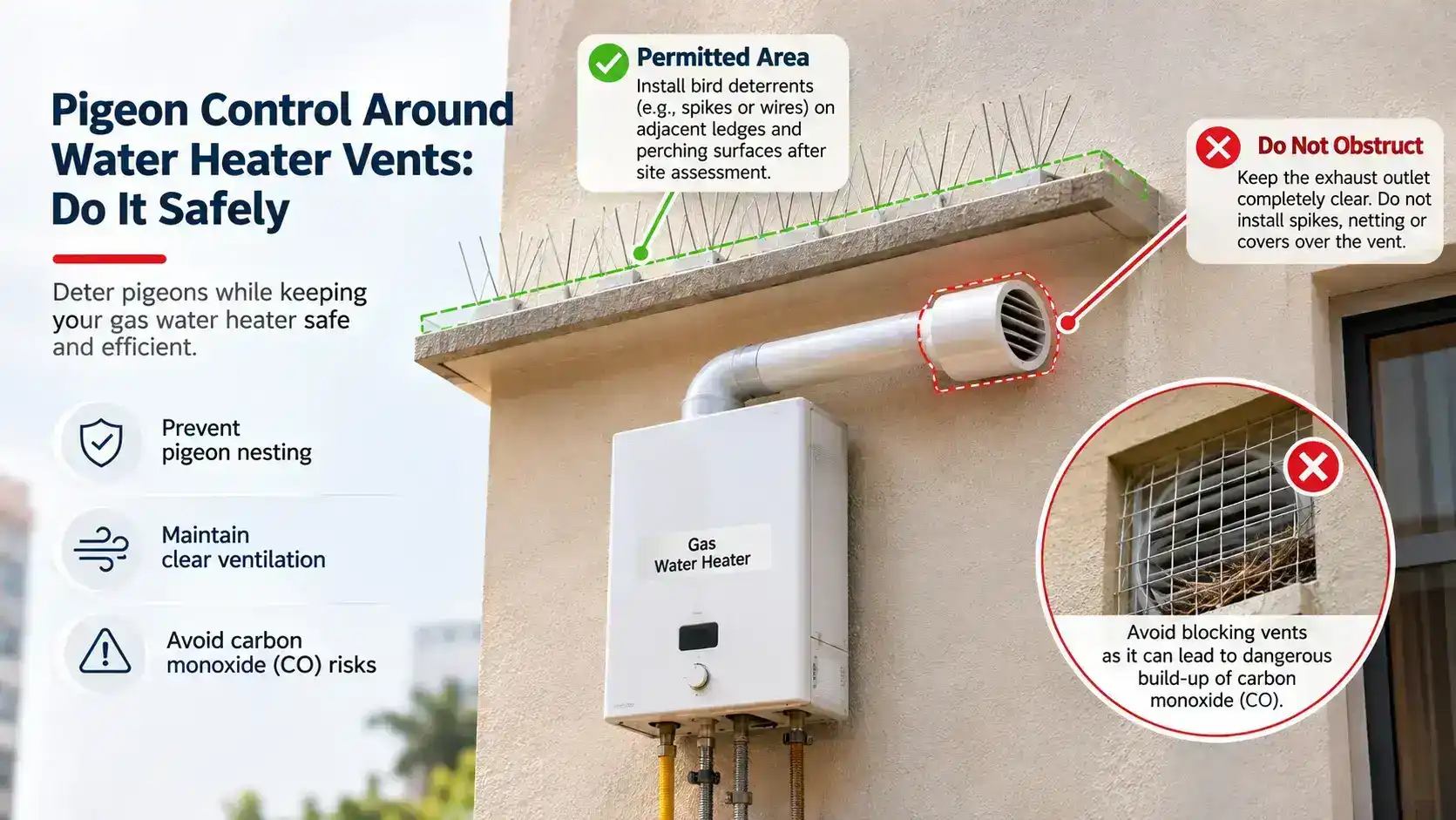
This creates a particularly important safety concern. Bird intrusion or nesting debris inside an exhaust system can restrict combustion-product discharge and potentially allow carbon monoxide to enter occupied spaces.
Repeated pigeon activity around AC units and water-heater installations can create maintenance, operational and hygiene concerns.
| Problem | Potential Impact |
|---|---|
| Dropping accumulation | Fouling of external surfaces and deterioration of certain building finishes. |
| Nesting material | Debris accumulation around equipment, ledges and drainage pathways. |
| AC maintenance interference | Restricted access to mounting brackets, panels and surrounding components. |
| Drainage concerns | Accumulated debris may interfere with nearby drainage or condensate discharge. |
| Flue obstruction | Potentially dangerous restriction of combustion-product discharge. |
| Ectoparasites | Active or abandoned pigeon nests may harbour bird-associated mites. |
| Repeated contamination | Recurring fouling of balconies, walls and service platforms. |
Pigeon droppings and nesting material can become a hygiene concern when they accumulate over time, particularly in poorly ventilated or enclosed spaces.
In India, Down To Earth has reported concerns about hypersensitivity pneumonitis, a lung condition associated with repeated inhalation of certain environmental antigens, including those associated with bird exposure.
Its 2023 report also discusses a 2019 study of patients with interstitial lung disease across 19 Indian cities, in which bird exposure was associated with higher odds of hypersensitivity pneumonitis relative to other forms of interstitial lung disease. (Source)
However, this does not mean that casual contact with an individual dropping will cause illness. The more relevant concern is repeated exposure to contaminated dust and accumulated bird debris.
The University of Missouri Extension also identifies pigeon droppings as corrosive, particularly to building surfaces, and notes the importance of managing accumulated nesting and roosting debris.
Effective pigeon management involves selecting exclusion methods based on the structure, available landing surfaces and surrounding equipment. Common approaches include:
Water-heater exhaust systems require a different approach from ordinary pigeon-perching surfaces. The objective is to prevent birds from accessing adjacent ledges while keeping the exhaust terminal completely functional.
Consider the following precautions:
A pigeon deterrent should never compromise combustion-air supply, exhaust discharge or appliance safety clearances.
Research on urban pigeon management supports a combined approach: physical exclusion, management of nesting opportunities and reduction of accessible food sources. Two field studies help explain why treating only the visible ledge may not be enough.
Proofing one AC ledge while leaving adjacent balconies, ducts and parapets accessible can simply shift pigeon activity to another part of the building.
This is why pigeon management should consider the surrounding structure and environmental conditions, rather than treating each affected surface in isolation.
In Indian residential societies, regular pigeon feeding can also contribute to persistent activity around buildings. A 2014 University of Jammu study, discussed in Down To Earth's reporting on pigeon populations in Indian cities, found that food voluntarily provided by people contributed substantially to pigeon nutrition in Jammu.
This does not mean that every pigeon problem is caused by feeding. It does, however, highlight the importance of managing accessible food sources alongside nesting and roosting opportunities. Housing societies should also check their applicable bylaws and local civic-body directions when addressing communal feeding areas.
For residential societies, commercial properties and high-rise buildings, a structured programme should include four essential stages.
| Stage | Recommended Activity |
|---|---|
| Structural Assessment | Inspect AC installations, balconies, service ducts, water-heater surrounds and recurring nesting locations. |
| Solution Selection | Choose bird spikes, Bird Spider, netting or other suitable exclusion systems based on building geometry. |
| Cleaning and Installation | Remove accumulated debris through controlled procedures and install deterrents without affecting equipment operation. |
| Monitoring and Maintenance | Inspect netting, fixings, spikes and newly emerging landing locations periodically. |
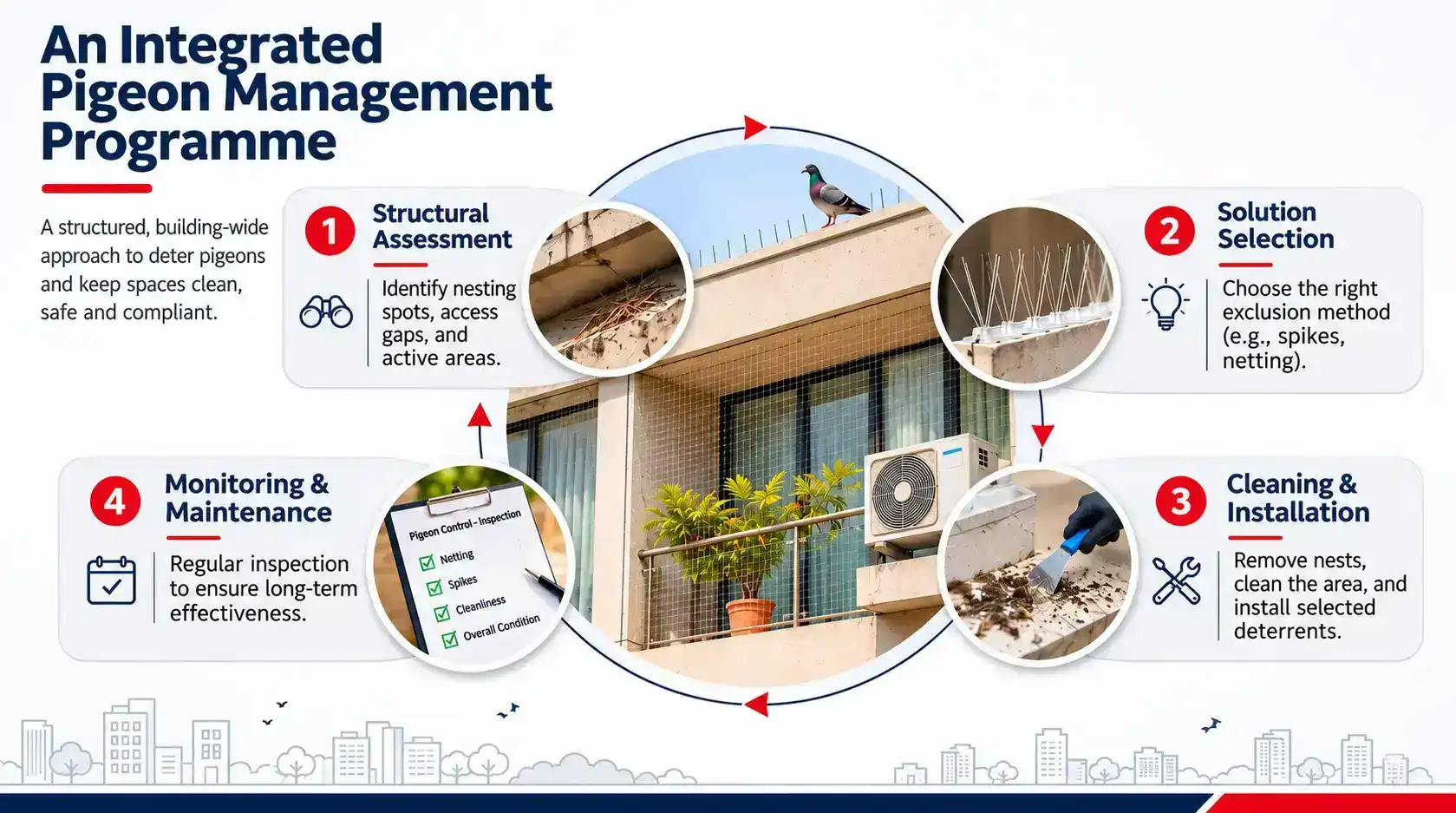
Different building features require different exclusion strategies. Bird netting may be appropriate for a large recessed service area, whereas bird spikes or Bird Spider systems may be more suitable for exposed ledges and equipment surrounds.
For offices, warehouses, hospitality facilities and other commercial premises, commercial bird management solutions for buildings and business premises can form part of a wider property-management and hygiene programme.
AC outdoor-unit installations often provide elevated, sheltered and relatively undisturbed surfaces. Gaps around mounting brackets, overhead projections and adjacent walls can create suitable resting and nesting locations. Winter may make sheltered surfaces more appealing, but there is no direct research establishing a specific winter preference for AC units.
Identify the exact nesting location first. Depending on the installation, suitable measures may include Bird Spider systems, bird spikes or professionally installed netting. Any solution must preserve airflow, drainage, equipment clearances and servicing access.
Pigeons may be attracted to elevated ledges, sheltered recesses and surrounding structural openings. Intermittent warm-air discharge from a gas water heater may contribute to local microclimates, but architectural features and accessibility are also important factors.
Spikes may be installed on suitable adjacent perching surfaces, provided they do not obstruct the exhaust terminal, combustion-air openings or manufacturer-specified clearances. They must never be installed across a flue outlet.
Yes. Properly installed bird netting can physically restrict access to recessed spaces and nesting locations. It should be securely fixed and designed to preserve AC airflow, drainage and maintenance access.
Not necessarily. Rock pigeons are non-migratory and can breed throughout the year in urban environments. If a pair has established a regular roosting or nesting location, it may continue using the site beyond winter unless access is addressed.
The presence of a pigeon near the external vent does not automatically mean the flue is blocked. However, if nesting material or obstruction is suspected inside the flue, stop using the appliance until an authorised gas-appliance technician has inspected it. A blocked flue can cause carbon monoxide to enter occupied spaces.
Pigeons choosing AC ledges and water-heater surroundings during winter are responding to suitable architectural and environmental conditions. Elevated surfaces, sheltered recesses, accessible nesting spaces and reduced disturbance can make these locations attractive for repeated perching and nesting.
However, pigeon activity is not limited to winter. Their non-migratory behaviour and year-round breeding in Indian urban environments mean that established roosting locations can remain active across seasons.
Effective pigeon management requires identifying specific roosting locations, assessing surrounding access points and implementing physical exclusion systems suited to each application. For AC outdoor units, this may involve appropriately positioned Bird Spider devices, bird spikes or netting that preserve equipment clearances.
Around water-heater installations, deterrents must protect adjacent surfaces without interfering with exhaust discharge or combustion ventilation.
Rentokil PCI's professional bird control services for residential and commercial properties focus on assessing site-specific bird activity and identifying suitable exclusion and prevention measures for affected building areas.
Looking to prevent pigeons from nesting around your building's AC units, balconies or external ledges? Contact Rentokil PCI to discuss suitable bird-exclusion solutions for your property.
Occasional bird sightings do not necessarily indicate an established nesting problem. Recurring activity deserves attention before nesting and debris accumulation become more difficult to manage. Look for recurring signs: