Click Here To
Contact Us
Chat with us
WhatsApp us
Call us
1800-212-2125

Powder Post Beetles vs. Drywood Termites: How to Identify Frass

Short Answer

How do you distinguish powder post beetle frass from drywood termite droppings?

Powder post beetle frass is typically a fine, flour-like powder with a smooth, talc-like texture. It may trickle out of tiny, round exit holes in the wood.

Drywood termite frass consists of hard, granular pellets with ridged sides and six-sided profiles under magnification. These pellets are commonly found in small piles beneath pinhead-sized kick-out holes.

The hole measurements can overlap, so size alone is not sufficient for identification. Examine the debris under a magnifier and look for fresh deposits after cleaning. If the pest remains uncertain, arrange a professional identification before attempting treatment.

What is Frass, and Why Does it Appear First?

Frass is the waste material produced by insects feeding within wood. It is often one of the earliest visible indicators of an infestation because the insects themselves remain concealed inside the timber.

Powder post beetle larvae tunnel through wood for months before emerging as adults through small, round exit holes. Drywood termites, in contrast, live entirely within the timber and push their waste out through small openings known as kick-out holes.

In both cases, the debris falling from the wood may be the only external evidence of activity. The US National Park Service's guidance on identifying insect pest damage notes that, apart from the characteristic pellets, there is very little outward sign of drywood termite attack because the insects work just beneath the wood surface.

Powder Post Beetles vs. Drywood Termites: How to Identify the Difference

The texture, shape and location of frass are more useful for distinguishing these pests than hole size alone.

Identification Feature Powder Post Beetles Drywood Termites
Frass Texture Fine, dust-like powder resembling flour or talc Hard, granular pellets resembling coarse pepper
Frass Shape No distinct structure visible, even under magnification Elongated pellets with ridged sides and six-sided profiles under magnification
Hole Size Approximately 0.8-1.6 mm for the true powder post (Lyctid) group Kick-out holes generally less than 2 mm
Frass Location Often packed inside tunnels, falling out of exit holes in small piles Commonly accumulates beneath kick-out holes on surfaces below the infested wood
Wood Preference Starch-rich hardwood sapwood, bamboo and plywood Dry, sound wood, including furniture
Additional Indicators Dead adult beetles near windows and newly appearing holes Shed wings after swarming, with few other visible signs

Sources: 

An important distinction is that the presence of a small hole does not automatically identify the pest. Both groups can produce openings within similar size ranges. The physical characteristics of the frass should be considered alongside the wood type, surrounding evidence and signs of continuing activity.
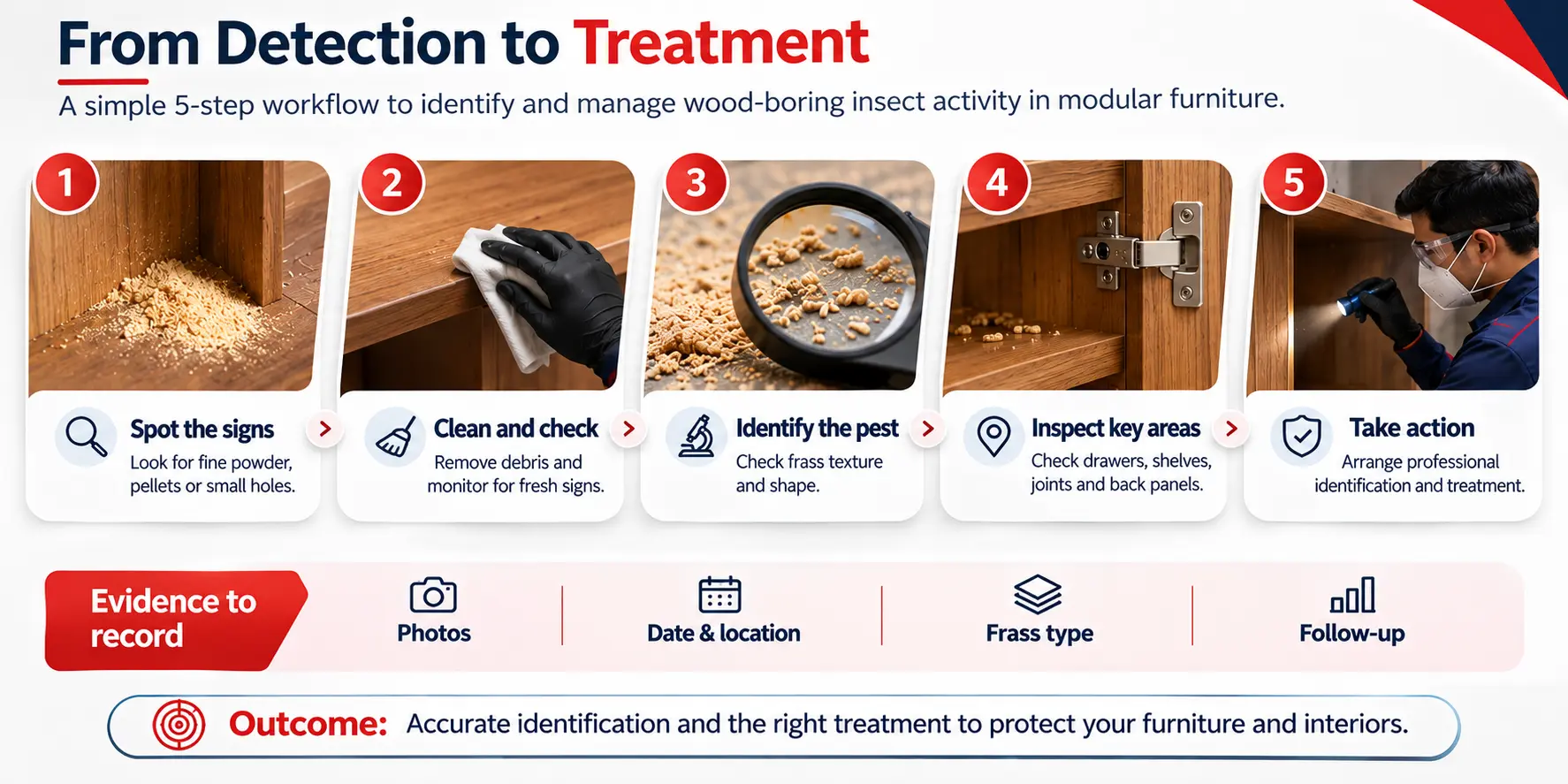
A Quick Five-Step Check at Home

How to Identify the Pest:

Before arranging treatment, a few simple observations can help narrow down the possible source of the debris.

1. Collect a sample: Tap or brush a small quantity of the debris onto a sheet of white paper. Photograph the original pile, including a coin beside it for scale. This provides a useful reference for professional identification.

2. Examine the texture: Rub a small quantity of frass between your fingers. University of California IPM recommends this as an initial identification check.

Powder post beetle frass typically feels like talcum powder. Deathwatch beetle frass feels grittier, while false powder post beetle frass is often tightly packed inside tunnels and difficult to dislodge.

3. Inspect the debris under magnification: Use a hand lens or a phone's macro camera to examine individual particles.

Drywood termite are described as pellets as granular, with ridges along their sides and six hexagonal faces. Powder post beetle frass does not display the same distinct pellet structure. 

4. Examine the exit hole, but do not rely on its size alone: The US National Park Service lists true powder post beetle exit holes at approximately 0.8-1.6 mm. UC IPM describes drywood termite kick-out holes as generally less than 2 mm.

These measurements overlap, so hole diameter cannot reliably distinguish the two

Some guides also describe a ballpoint pen test for differentiating beetle groups: only the tip of a pen fits into a true powder post beetle hole, while more of it fits into deathwatch and false powder post beetle holes. This helps distinguish beetle groups from one another, not beetles from termites.

5. Clean the area and check again: Wipe the debris away and inspect the location after a few days. New pellets or powder appearing after cleaning may indicate continuing activity.

However, there are guides cautioning that frass or pellets alone cannot establish whether an infestation is active or determine its full extent. Building vibrations can also dislodge old debris.

A practical way to monitor the area is to place a sheet of paper or tape beneath the suspected location so that fresh deposits are easier to identify. This is a suggested observation method rather than a published diagnostic protocol.

Five-step process for identifying and managing wood-boring insect activity in modular furniture.

Where to Look for Frass on Modular Furniture

Modular furniture can conceal wood-boring insect activity behind panels, inside compartments and along joints. The most useful inspection points are often those that are difficult to access during routine cleaning.

Check:

In order to protect wooden furniture, it is recommended to leave sufficient space around large units to inspect their backs and sides. It also highlights the importance of checking joints, undersides, drawers and enclosed compartments.

Which Types of Wood and Furniture are at Risk?

The two pest groups differ in their wood preferences, which can help narrow down the likely source of an infestation.

Wood-boring beetles, powder post beetles generally prefer wood with large pores and high starch content. Examples include oak, ash, hickory, mahogany and walnut, as well as bamboo.

Potential infestation sites include:

  • Hardwood furniture and wooden fixtures.
  • Plywood and wooden panelling.
  • Flooring, mouldings and window or door frames.
  • Bamboo articles and other untreated wooden products.

These beetles can attack wood with relatively low moisture content, even at approximately 8%.

There is limited reliable evidence on how frequently engineered boards such as MDF and particle board are attacked. Therefore, it would be inaccurate to assume that all modular board materials carry the same risk.

Many modular furniture units combine engineered boards with solid-wood frames, edging, veneers or other timber components. These solid-wood sections and unfinished surfaces deserve particular attention during inspection.

UC IPM also notes that beetles lay eggs on unfinished surfaces and in cracks, making exposed back panels, cut edges and joints important inspection points.

Can Newly Purchased Modular Furniture Arrive with an Infestation?

Yes. Wood-boring beetle infestations can originate before furniture reaches the home.

Beetles or their larvae can be introduced into buildings through infested furniture. Some infestations may also originate in raw timber at the mill before the wood is manufactured into furniture.

This is worth considering when fine powder or fresh holes appear soon after installation. The infestation may have existed in the timber before the furniture was delivered.

Inspecting back panels, undersides, exposed edges and joints before accepting or installing new furniture can help identify visible signs early.
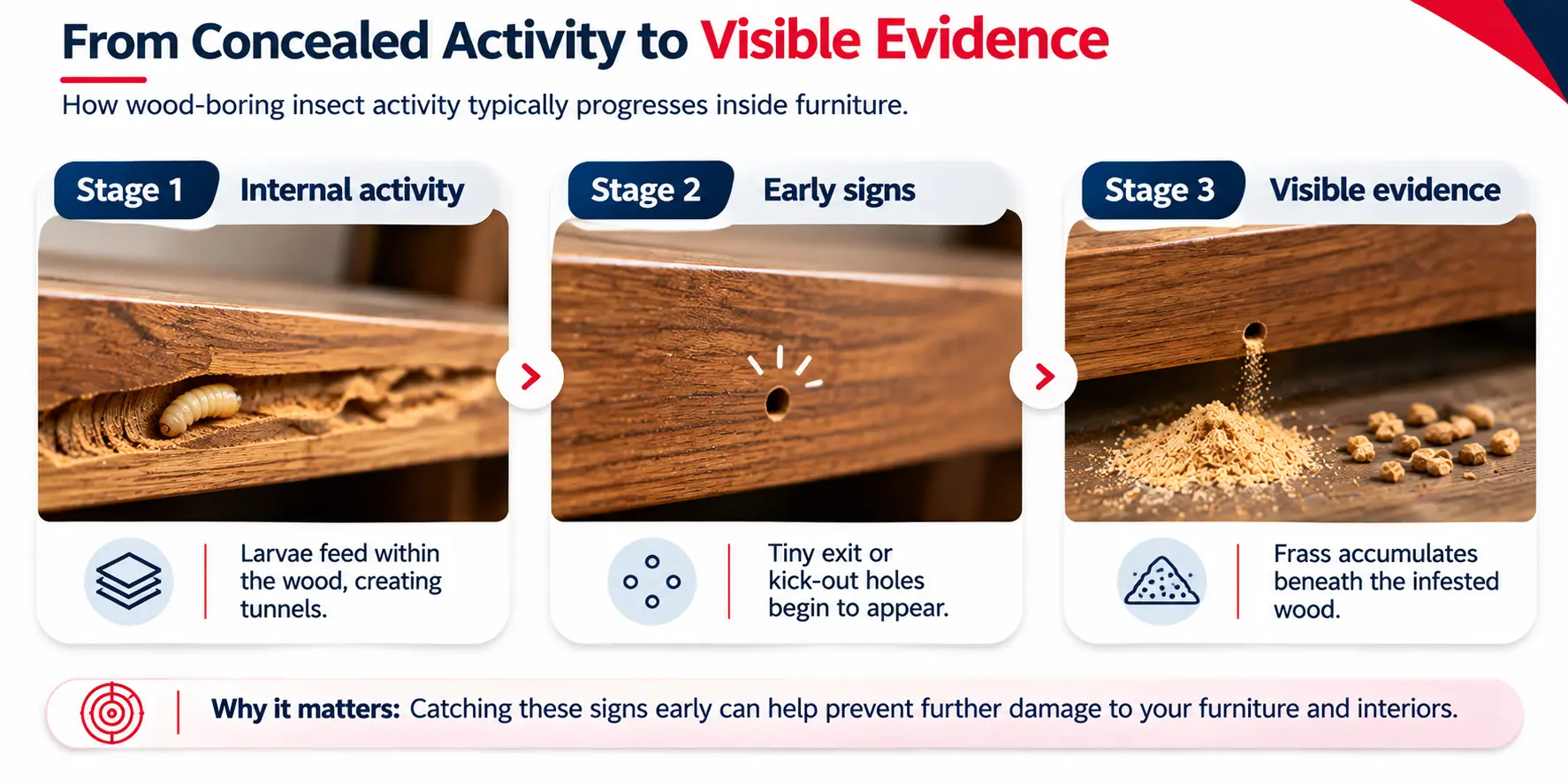
Three stages of wood-boring insect activity showing internal tunnels, small exit holes and visible frass deposits.

Termites are significant wood-damaging pests in India, with considerable diversity across the country. The Zoological Survey of India's 2025 Fauna of India Checklist (Version 2.0) records 321 termite species and four subspecies belonging to 53 genera and eight families.

It also notes that drywood termites inhabit structural wood and furniture, highlighting their relevance to residential and commercial properties.

The checklist identifies Cryptotermes dudleyi, a drywood termite species, as invasive in India.

However, much termite damage commonly encountered in Indian homes is associated with subterranean termites. These termites establish colonies in soil and may access buildings through foundations, concealed openings and mud tubes rather than producing the characteristic dry pellets of drywood termites.

Termite activity may be indicated by mud tubes, hollow-sounding woodwork and discarded wings. The physical characteristics of different termite species and their identification features can help distinguish the likely source of infestation.

The powder post beetle Lyctus brunneus is associated with dry, untreated, starch-rich wood and is among the wood-boring beetle species that can damage timber.

Consequently, fine debris found near modular furniture in an Indian home should not automatically be classified as termite activity. The distinction matters:

  • Mud tubes may indicate subterranean termite activity.
  • Hard, six-sided pellets may indicate drywood termites.
  • Fine, talc-like powder may indicate powder post beetles.

Correct identification is important because these pests differ in their biology, infestation patterns and treatment requirements.

What can be Mistaken for Powder Post Beetle or Termite Frass?

Not every deposit of fine powder around furniture is caused by wood-boring insects.

Carpentry and drilling dust: Newly installed modular interiors can produce sawdust and drilling debris. Dust that appears once, does not return after cleaning and has no associated exit holes may be construction residue. This is a practical observation rather than a definitive diagnostic rule.

Carpenter ants: Carpenter ants excavate wood to establish nests but do not consume it. UC IPM notes that carpenter ants and wood-boring beetles can both be confused with drywood termites.

The US National Park Service also identifies a wing distinction: winged termites have four wings of equal length, whereas carpenter ants have two pairs of different lengths.

Other wood-boring beetles: Not all beetle frass has the same texture. Deathwatch beetle frass contains very small pellets and feels grittier than powder post beetle frass. False powder post beetle frass is generally coarser, tightly packed and may stick together. Rentokil PCI's wood-borer species guidance provides further information on other beetles that may infest timber.

Other beetle species can also infest timber, with differences in their wood preferences and the damage they cause. These include several types of wood-boring beetles.

What Should You do if You Find Frass on Wooden Furniture?

If you notice fine powder or pellets near a wardrobe, bed frame, kitchen unit or other wooden fixture, avoid immediately applying household insecticides. First, establish what is producing the debris.

Do's and Don'ts:

Do:

  • Photograph the frass, the suspected exit hole and the surrounding wood.
  • Retain a small sample for identification.
  • Inspect other wooden items nearby, particularly those touching the same wall.
  • Check surrounding walls, floors and skirting boards. Termite activity may originate elsewhere in the property rather than from the furniture showing visible damage.
  • Contact the furniture supplier or installer and review the applicable warranty conditions.
  • Arrange professional pest identification before selecting a treatment.

Do not: 

  • Spray household insecticide over the wood. UC IPM does not recommend DIY treatments for drywood termites; the products and methods required are not suitable for routine homeowner application.
  • Assume that applying polish or paint will eliminate an infestation. UC IPM explains that borate treatments for beetles must penetrate the wood, making successful treatment of finished wood difficult.
  • Move the suspected infested furniture next to other wooden items while awaiting identification.

What Treatment Options are Available for Powder Post Beetles and Drywood Termites?

Treatment depends on the pest species, extent of infestation, location of the affected timber and accessibility of the galleries inside the wood.

Different approaches are described for powder post beetles and drywood termites.

Treatment for Powder Post Beetles:

  • Removal and replacement: Infested wood can be removed and replaced where practical.
  • Borate-based treatment: Where removal is not feasible, bare wood may be treated with suitable borate-based products applied by a licensed operator. The treatment needs to penetrate the wood.
  • Whole-structure fumigation: Used for extensive infestations, although it does not prevent subsequent reinfestation.
  • Heat or freezing: Small wooden items may be treated using these methods, depending on their construction and materials. Items containing fabrics, pelts or paints may not be suitable.

Treatment for Drywood Termites:

  • Localised treatment: May involve injecting an appropriate treatment into termite galleries or replacing infested wood.
  • Whole-structure treatment: Fumigation or heat treatment may be considered for more extensive infestations.

Localised treatment depends on accurately locating the infestation. UC IPM cautions that it is difficult to be certain every affected gallery has been treated.

Treatment options for powder post beetles and drywood termites vary according to the pest species, extent of infestation and condition of the affected timber. A professional termite inspection helps assess the infestation, while the appropriate termite control treatment depends on the findings and site requirements.

How can you reduce the risk of infestation in new modular furniture?

Prevention begins before the furniture is installed. Inspecting timber components, managing moisture and retaining access to concealed sections can help reduce the risk of unnoticed wood-boring insect activity.

  1. Inspect furniture on delivery: Examine back panels, edges, undersides and joints before accepting and installing the units.
  2. Understand the materials used: Ask the supplier which boards, veneers and solid-wood components are included and whether preservative treatment has been applied.
  3. Seal exposed wood: UC IPM recommends painting or varnishing suitable unfinished surfaces to seal pores, cracks and holes where beetles may lay eggs.
  4. Keep furniture dry: Repair plumbing leaks and avoid persistent moisture accumulation around wooden fixtures. The US National Park Service also identifies moisture reduction as an important consideration in managing powder post beetles.
  5. Leave inspection access: Maintain sufficient clearance behind and beneath large units to allow periodic inspection.
  6. Plan pest treatment before installation: Treating relevant pest risks before modular interiors are fitted can improve access to concealed areas. Our article on why pest treatment must happen before modular interiors and painting explains the importance of treatment sequencing.

Frequently Asked Questions

Powder post beetle frass is a fine, dust-like powder with a texture similar to flour or talcum powder. It is produced as larvae tunnel through wood and may fall out through small, round exit holes.

Drywood termite droppings are hard, granular pellets with ridged sides and six-sided profiles under magnification. They are commonly deposited in small piles beneath kick-out holes in infested wood.

Not reliably. True powder post beetle exit holes are approximately 0.8–1.6 mm, while drywood termite kick-out holes are generally less than 2 mm. Since these ranges overlap, examine the frass texture and shape as well.

Not necessarily. Frass can remain after insect activity has stopped, and vibrations may dislodge old debris. Clean the area and inspect it again after a few days. Fresh deposits or newly appearing holes may indicate continuing activity.

Yes. UC IPM lists plywood among the materials where powder post beetle infestations may occur, alongside hardwood furniture, panelling, flooring and bamboo articles. Reliable information on the frequency of attacks in MDF and particle board is limited.

DIY treatment is not recommended as a reliable solution. Drywood termites live inside wood, making complete treatment difficult. Borate-based treatments for powder post beetles also require penetration into suitable bare wood, which makes finished furniture challenging to treat.

Not necessarily. Treatment options depend on the pest, extent of infestation, type of wood and accessibility of the affected areas. Professional identification should come before deciding whether to treat, repair or replace the furniture.

Next steps: Get the Infestation Identified Correctly

Fine powder or granular pellets beneath wooden furniture can indicate different types of wood-boring insects. Since powder post beetles and drywood termites require different treatment approaches, identifying the pest is the first step towards effective management.

If you notice unexplained frass, exit holes or signs of wood damage, contact Rentokil PCI to arrange a professional inspection. You can also find a local branch or book a pest control service online.

Key Takeaways

  • Frass texture is the first diagnostic clue: Powder post beetle frass is talc-fine, while drywood termite frass consists of hard, ridged pellets.
  • Hole size alone is inconclusive: Beetle exit holes and termite kick-out holes can overlap at approximately 1-2 mm.
  • Wood preferences differ: Powder post beetles favour starch-rich hardwood, bamboo and certain wood products, while drywood termites can infest dry, sound timber, including furniture.
  • Frass does not confirm active infestation: Clean the debris and inspect the area again after a few days.
  • DIY treatment is not a reliable solution: Both pests develop and feed inside wood, making treatment of finished furniture particularly challenging.

Not Sure Which Termite Treatment Your Property Needs?

The right treatment depends on the construction stage, extent of termite activity and accessibility of the affected areas. Rentokil PCI provides professional termite management solutions, including chemical barrier treatment and termite baiting, based on property-specific requirements.

Book a Termite Inspection

Related posts