Registered Residential Customers
Manage Your Home Services
A car parked overnight may appear secure, but its engine compartment can become an attractive shelter for rats and other rodents, particularly during cooler months. Residual heat from a recently operated engine, protection from rain and wind, and concealed spaces can make the engine bay suitable for temporary shelter and nesting.
For vehicle owners, this can lead to more than an unpleasant discovery under the bonnet. Rats can gnaw through electrical wiring, damage insulation and rubber hoses, and introduce nesting debris into air intake systems. Depending on the components affected, this may cause electrical faults, vehicle performance issues and potential safety hazards.
Understanding why rats enter car engine bays, recognising early signs of activity and addressing rodent activity around the parking area can help reduce the risk of recurring damage.
Rats are opportunistic animals that seek accessible food, water and shelter. During cooler weather, a parked vehicle can offer a combination of favourable conditions that makes its engine compartment an attractive hiding and nesting location.
Research and vehicle-maintenance reports have documented rodent damage to wiring, hoses, insulation and air intake components, particularly in vehicles left unattended for extended periods.
Some reports suggest that certain vehicles use plant-derived or soy-based wiring insulation that attracts rodents. Other pest-management sources question whether this is the primary reason for the damage.
There is no conclusive independent evidence in the references reviewed here to establish that soy-based insulation is the main cause of rodent activity around vehicles.
The practical explanation remains broader: rats seek warmth and shelter, and accessible wiring and other materials may be gnawed once they enter the engine compartment.
Prevention should therefore focus on reducing access and addressing rodent activity around the parking area, rather than relying on assumptions about a particular type of wiring.
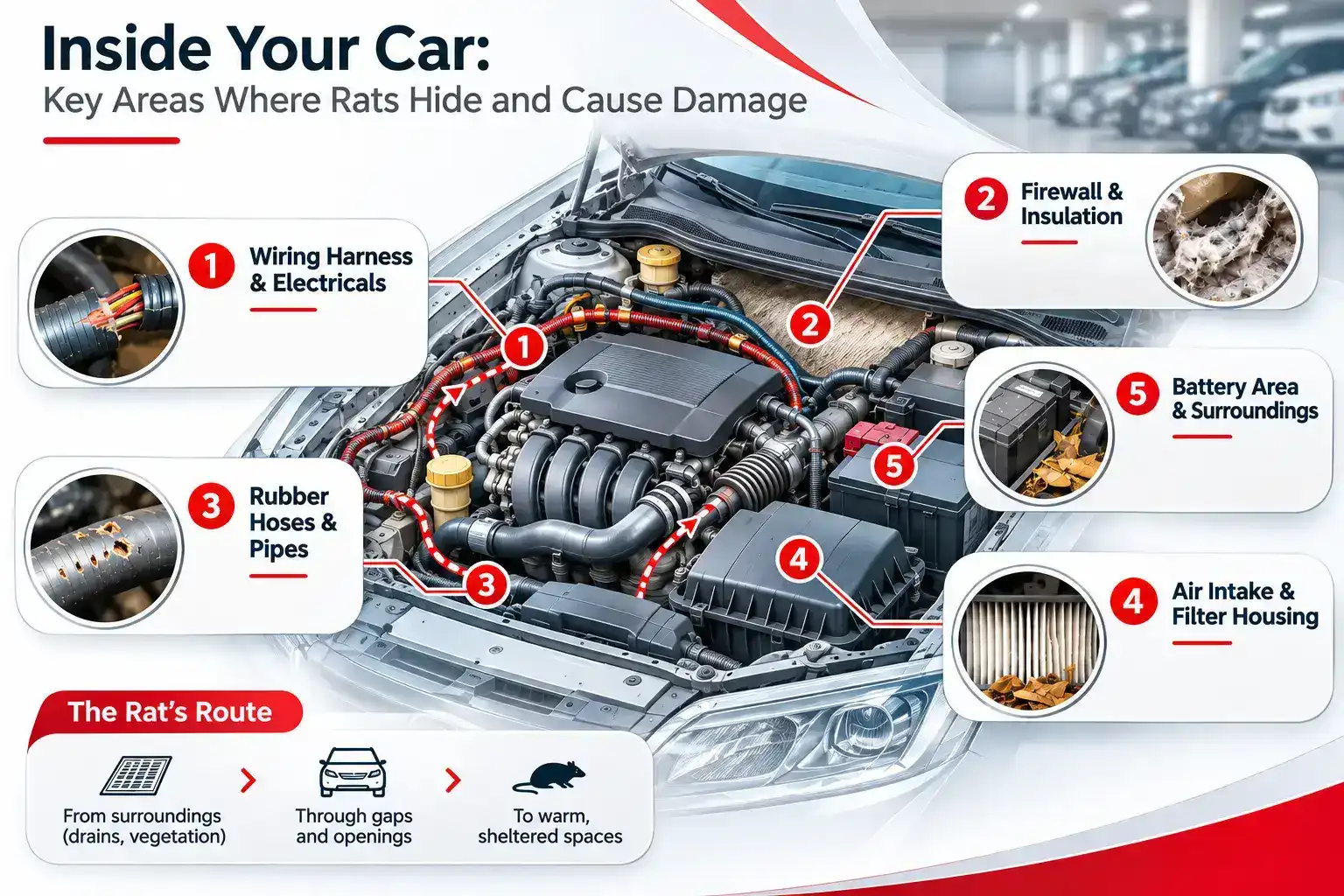
Once inside the engine compartment, rats may explore and gnaw on several components. The extent of damage depends on the vehicle design, rodent activity and duration of access.
| Vehicle Component | Potential Damage | Possible Consequence |
|---|---|---|
| Electrical wiring and harnesses | Gnawing and exposed conductors | Electrical faults, warning lights and starting problems |
| Rubber hoses and pipes | Bite marks, punctures and leaks | Fluid leakage or impaired component operation |
| Engine insulation | Torn or displaced insulation | Deterioration of heat and noise insulation |
| Air filter and intake housing | Nesting material and stored food | Restricted airflow and reduced engine performance |
| Plastic covers and connectors | Gnawing and breakage | Loose connections and component damage |
| Cabin air intake and filter | Nesting debris and contamination | Unpleasant odours and reduced ventilation quality |
Rodent activity is not always immediately visible. Rats are predominantly nocturnal and may enter and leave a parked vehicle without being noticed. However, there are early signs of rat infestation that you shouldn’t overlook.
Physical and operational indicators, such as droppings, nesting material, gnaw marks and unexplained electrical faults, can help identify a potential problem.
Small, dark, pellet-shaped droppings may be visible around the engine cover, battery area or other accessible sections of the engine compartment.
A persistent unpleasant or ammonia-like odour may also indicate rodent activity, particularly when the vehicle has remained parked for several days.
Inspect accessible wiring harnesses, cable insulation, rubber hoses and plastic covers for tooth marks, frayed edges or exposed material.
Do not pull, disconnect or handle damaged electrical components. Arrange a professional inspection if wiring damage is suspected.
Rats may collect dry leaves, shredded paper, cloth, plastic wrappers and other materials to construct nests.
These materials can accumulate around the engine cover, battery housing, air filter box and other sheltered spaces.
Electrical damage may cause warning lights, intermittent sensor faults, malfunctioning accessories or difficulty starting the vehicle.
These symptoms do not automatically indicate rat activity. However, when accompanied by droppings, nesting debris or visible gnaw marks, they warrant further inspection.
A burning smell, unusual rattling or an unfamiliar odour from the ventilation system may indicate damaged components or nesting material.
If smoke, burning smells or significant electrical faults occur, stop using the vehicle when safe to do so and arrange an inspection by a qualified mechanic.
Rat activity inside a vehicle can lead to several interconnected problems.
Rodents can carry pathogens and parasites, and their droppings, urine and nesting material may contaminate surfaces inside and around a vehicle.
The US Centers for Disease Control and Prevention (CDC) explains that some rodent-borne diseases can spread when contaminated particles become airborne. This is why droppings and nesting material should not be dry-swept or vacuumed.
If you suspect contamination, follow appropriate precautions before cleaning. If you feel unwell after exposure to rodent waste, inform a healthcare professional about the exposure.
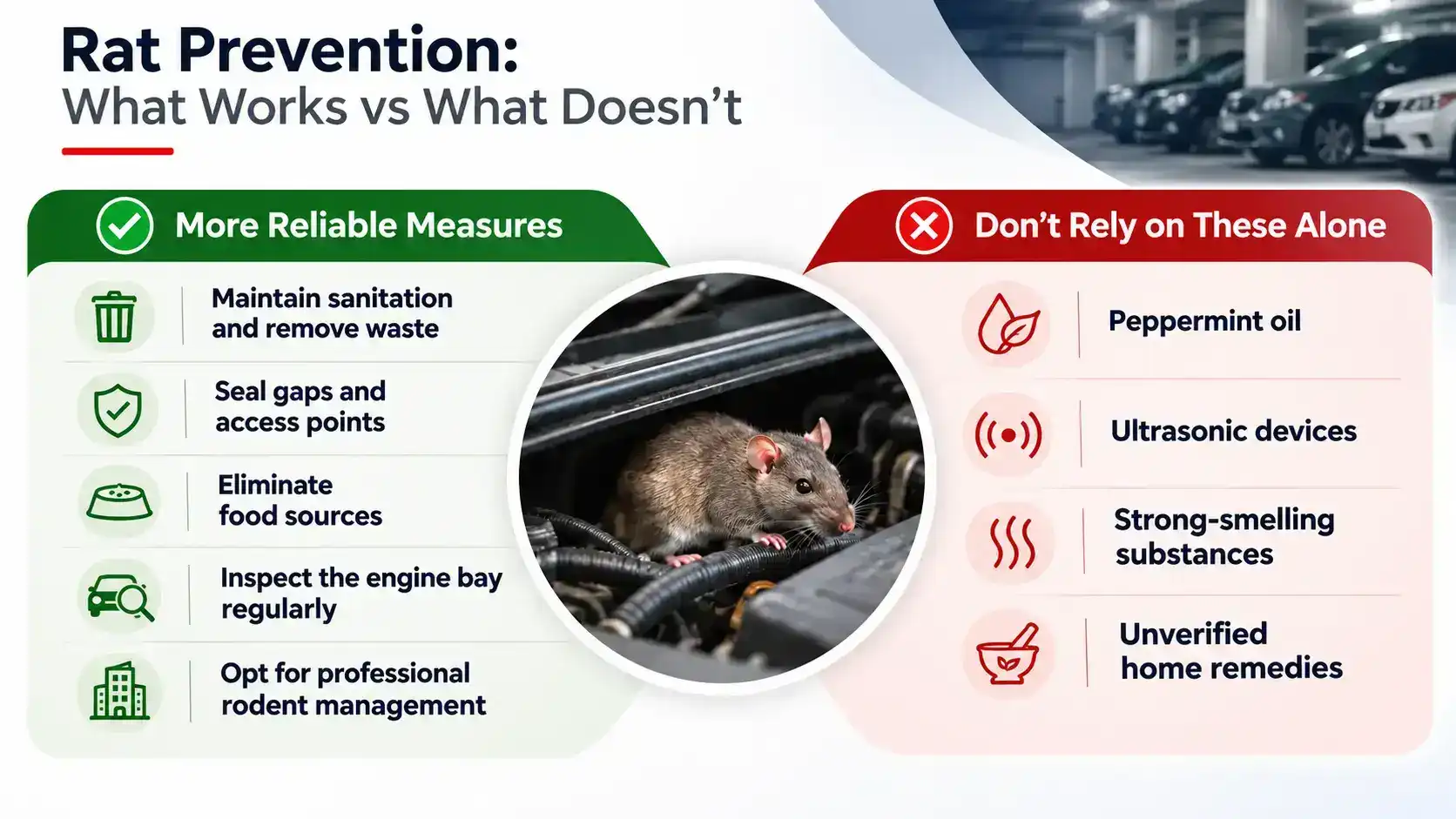
Preventing rat access requires more than applying a repellent under the bonnet. Vehicle owners should combine parking practices, environmental management, regular inspections and appropriate rodent-control measures.
Taking precautions against rat damage to car wiring and other vehicle components can further reduce the risk of recurring damage.
If you notice signs of rodent activity or suspected damage, have the vehicle inspected by a qualified automotive technician.
Regular checks can help identify rodent activity before extensive damage occurs. A quick visual inspection is particularly useful for vehicles parked for extended periods or in areas with known rodent activity
| Inspection Area | What to Check |
|---|---|
| Around the vehicle | Droppings, nesting debris and signs of rodent activity |
| Engine bay | Shredded paper, leaves, fabric and other nesting material |
| Battery area | Visible gnaw marks or accumulated debris |
| Wiring and hoses | Frayed insulation, bite marks or exposed material |
| Air filter housing | Nesting material or signs of obstruction |
| Cabin and boot | Food wrappers, droppings, gnawed upholstery and unusual odours |
| Parking area | Open drains, waste accumulation, vegetation and possible rodent entry points |
Important safety precaution: If you discover a nest, droppings or suspected wiring damage, do not start the vehicle or attempt to dismantle engine components. Avoid dry sweeping or vacuuming rodent waste. Arrange a professional inspection and ensure that any contaminated material is handled using appropriate cleaning and protective procedures.
The US Centers for Disease Control and Prevention (CDC) advises ventilating affected enclosed areas and disinfecting rodent waste before removal rather than sweeping or vacuuming it. Vehicle-specific electrical and mechanical work should be handled by a qualified technician.
Several products and home remedies are marketed as ways to keep rats away from vehicles. These include peppermint sprays, strong-smelling substances, ultrasonic devices and chemical repellents.
However, their effectiveness should not be assumed.
Strong odours may temporarily discourage some rodent activity, but they do not provide reliable physical exclusion. Their effect may diminish over time, particularly in exposed or ventilated engine compartments.
Some substances may also damage rubber, plastic, paint or electrical insulation.
Ultrasonic devices are marketed to produce high-frequency sounds intended to discourage rodents. However, evidence supporting their consistent effectiveness in controlling rats is limited.
The Santa Barbara County Mosquito and Vector Management District cautions that ultrasonic and high-frequency sound devices should not be relied upon for rodent prevention.
Mothballs and household chemicals should not be placed inside engine compartments as improvised rodent repellents. These products are not designed for this application and may create chemical exposure, material compatibility or fire-safety concerns.
| Common Belief | What to Know |
|---|---|
| Ultrasonic devices will keep rats away permanently. | Their effectiveness is not consistently established, and they should not be relied upon as a standalone control method. |
| Peppermint oil and other plant scents prevent rat infestations. | Strong scents do not provide reliable exclusion or long-term rodent management. |
| Parking inside a garage guarantees protection. | Rodents can still access vehicles in garages with structural gaps, clutter or food sources. |
| A clean car cannot attract rats. | Vehicle hygiene helps remove food attractants, but warmth and shelter may still make the engine compartment accessible to rodents. |
| Starting the car regularly guarantees prevention. | Regular use may reduce opportunities for undisturbed nesting, but it does not eliminate the risk. |
When rats repeatedly enter vehicles parked in residential societies, office complexes or commercial facilities, treating individual cars may not address the underlying problem.
The surrounding environment may contain multiple harbourage locations, food sources and access routes that support ongoing rodent activity. A car may simply be one of several places rodents access within the premises.
Two common rat species are the roof rat and the Norway rat.
Relatively agile climbers and are often associated with trees, shrubs, dense vegetation, roof spaces and upper parts of buildings.
Stockier burrowers and are more commonly associated with ground-level areas, basements, foundations, drains and accumulated rubbish.
As a general pattern, ground-level and basement parking may encounter burrowing rats, while open parking beside trees and climbing vegetation may be more exposed to roof rats. This is not a rule; an inspection is needed to identify the species and activity present at a particular site.
| Preventive Measure | Recommended Action |
|---|---|
| Waste management | Use covered bins, prevent waste accumulation and maintain regular collection schedules. |
| Vegetation management | Trim overgrown plants and remove accumulated garden debris near parking spaces. |
| Structural proofing | Inspect and seal suitable gaps and openings that may allow rodent entry. |
| Drainage maintenance | Maintain drain covers and address damaged or unsecured openings. |
| Housekeeping | Keep parking areas, storage spaces and utility rooms free from clutter. |
| Activity monitoring | Track recurring sightings, identify common access points and coordinate corrective action with the building management team. |
A coordinated approach helps address the environmental conditions supporting rodent activity rather than relying solely on individual vehicle owners to manage the problem.
When rats repeatedly enter vehicles parked in a residential society, office complex or commercial facility, the surrounding premises may require a structured rodent management programme.
An effective programme should go beyond placing control products in visible areas. It should identify harbourage locations, food sources, access routes and conditions contributing to recurring activity.
The ERDM approach to rat management:
For residential societies, commercial parking facilities and office complexes, addressing the wider rodent population is important for reducing repeated encounters with parked vehicles.
Rats may enter engine compartments because recently operated engines retain heat. The enclosed space also provides shelter from wind, rain and potential predators, making it an attractive resting or nesting location during cooler weather.
Yes. Rats can gnaw through electrical cable insulation and wiring harnesses. This may expose conductors, interrupt electrical connections, trigger dashboard warnings and affect vehicle operation.
Look for droppings, shredded leaves or paper, nesting material, gnaw marks, damaged wiring and unusual odours. Repeated electrical faults may also indicate possible rodent damage and should be investigated.
Regular vehicle use may reduce the time available for rodents to establish undisturbed nesting sites. However, it does not guarantee prevention, particularly when rodent activity is high around the parking location.
Ultrasonic devices should not be relied upon as a standalone rodent-control method. Their effectiveness in preventing rats from entering vehicle engine compartments is not consistently established.
Do not start the vehicle or handle the nest and droppings with bare hands. Avoid sweeping or vacuuming the material. Arrange an inspection by a qualified automotive technician, particularly if wiring, hoses or filters may have been damaged. Any contaminated material should be cleaned using appropriate protective and disinfection procedures.
Housing societies should investigate common areas such as basements, drainage systems, waste collection points, landscaped spaces and utility areas. Identifying and addressing shared access routes and environmental conditions can help reduce recurring rodent activity around parked vehicles.
No. Although cooler weather may make sheltered engine compartments more attractive, rats can enter vehicles throughout the year whenever suitable access, shelter and nesting opportunities are available.
Damaged electrical wiring can create short circuits and other electrical faults, which may increase fire risk. If you suspect wiring damage, have the vehicle inspected by a qualified automotive technician before using it.
A car engine bay can provide rats with warmth, shelter and concealed spaces, making parked vehicles vulnerable to rodent activity during cooler months. Once inside, rats may damage wiring, hoses, insulation and other components, resulting in electrical faults, operational issues and costly repairs.
Preventing this damage requires a combination of regular vehicle inspections, hygienic parking conditions, suitable vehicle protection and effective rodent management around the surrounding premises.
For recurring rodent activity, addressing the wider infestation is just as important as protecting the vehicle itself.
Concerned about rat activity in your commercial premises?
If you notice recurring rodent activity around your premises, professional rat and rodent control solutions can help identify harbourage areas, implement targeted control measures and recommend preventive measures to minimise the risk of reinfestation. Call 1800-212-2125 for assistance.
After your vehicle has been parked for an extended period, take a moment to check for signs of rodent activity.
Before engaging a service provider for recurring rodent activity, property owners and facility managers should understand the proposed treatment and monitoring programme.