Registered Residential Customers
Manage Your Home Services
Festive cleaning is often focused on visible surfaces, kitchens, cupboards and floors. But preparing your home for Navratri and the festive season is also a good opportunity to inspect the less obvious places where pests can enter, hide or find favourable conditions.
Areas behind appliances, under sinks, around windows, inside storage spaces and near plumbing can remain undisturbed for long periods. Identifying these pest hotspots before Navratri can help you address potential problems before increased cooking, decorations, visitors and household activity begin.
A clean home is not necessarily a pest-free home. Regular cleaning removes food residue, dust and clutter, but it may not address concealed entry points, moisture or areas that pests use as shelter.
This is particularly relevant during Navratri and other festivals, when homes may have:
An apartment pest inspection does not mean checking every surface. It means identifying locations and conditions that could support pest activity.
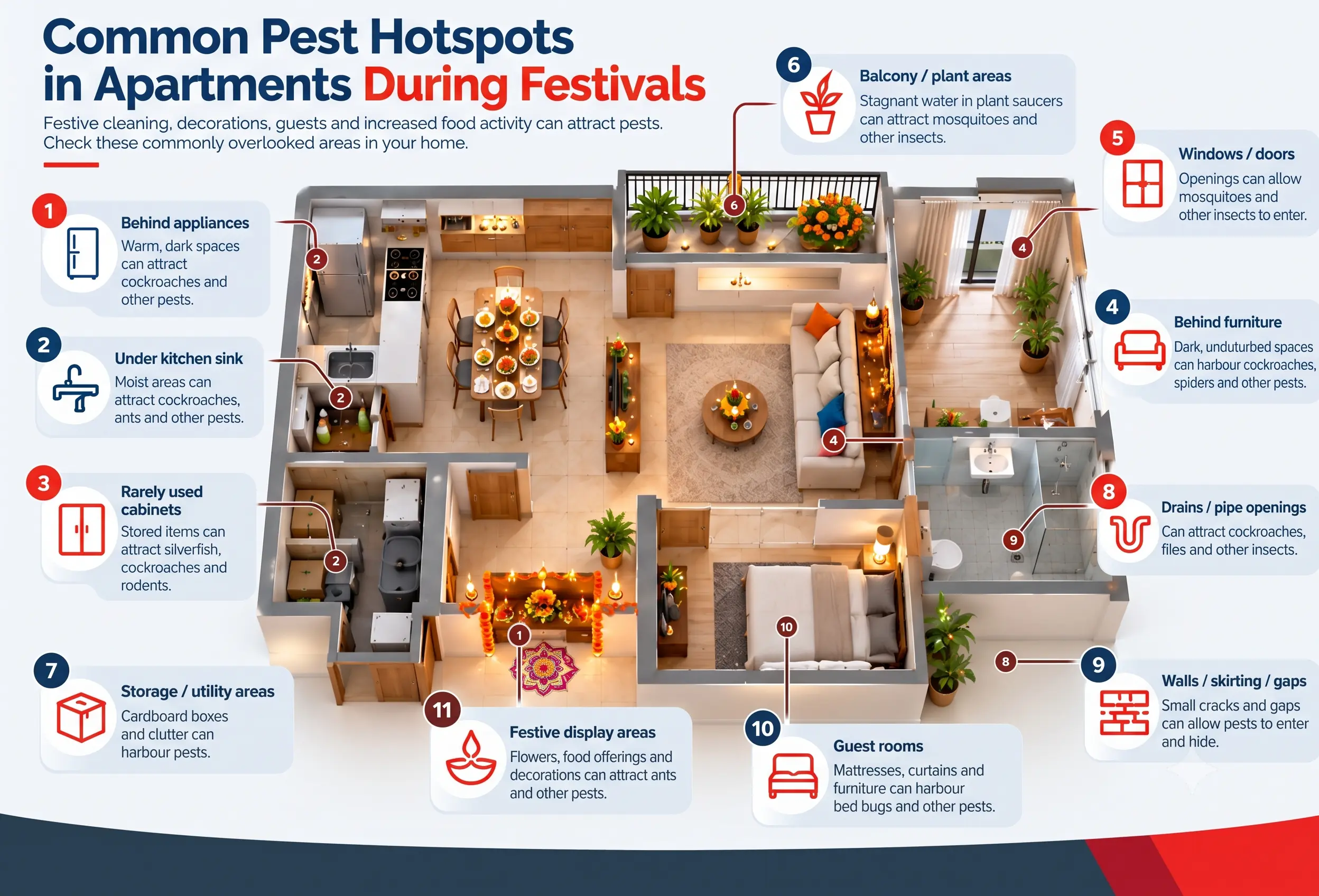
Refrigerators, washing machines, dishwashers and cooking appliances can create warm, dark and relatively undisturbed spaces.
Food particles, grease and moisture may also accumulate around these areas.
Check for: food residue, moisture, clutter, gaps and access points.
For cockroach-specific information, see 10 ways to eliminate cockroaches from your home.
The space beneath the sink is often occupied by cleaning products, bins or stored items and may not be inspected regularly.
Leaking pipes and persistent dampness can make this area particularly relevant during a pest inspection.
Check for: leaks, dampness, gaps around pipes, food residue and clutter.
If you notice recurring moisture, address the source rather than simply drying the area after each cleaning.
Cupboards that are opened infrequently can become undisturbed spaces, especially when they contain cardboard packaging, paper products or items that are rarely used.
Before Navratri, remove unnecessary items and inspect the corners, shelves and rear sections.
Check for: moisture, damaged packaging, food residue, clutter and concealed gaps.
If these cupboards contain festive decorations, carry out a separate inspection of the decorations themselves.
Wardrobes, cabinets, sofas and other large furniture can leave narrow, sheltered spaces against walls.
These areas may also conceal gaps around skirting or walls that are difficult to notice during routine cleaning.
Check for: accumulated debris, moisture, gaps, damaged skirting and other potential access points.
Moving furniture during festive cleaning can be a useful opportunity to inspect these areas without making furniture movement the focus of the cleaning routine.
Windows and balcony doors are potential entry points for insects, particularly where there are gaps, damaged screens or poorly sealed frames.
This can become more relevant around the festive season when windows and doors may remain open more frequently.
Check for: gaps around frames, damaged mesh, insects around light sources and accumulated debris.
If your festive preparations coincide with post-monsoon insect activity, our guide to common insects after rain provides additional context on seasonal insect activity.
Balconies can provide moisture, plant debris, stagnant water and sheltered corners that are easy to overlook.
Flower pots, trays and areas behind planters should be checked before festive decorations or lighting are installed.
Check for: stagnant water, damp areas, decaying plant material, excessive debris and gaps around doors or walls.
Removing standing water is particularly important where mosquitoes are a concern.
Storage rooms, utility balconies, lofts and rarely accessed cupboards often contain cardboard, paper, fabric and other household materials.
Because these spaces are usually disturbed less frequently, potential pest problems can remain unnoticed.
Check for: excess cardboard, moisture, clutter, damaged packaging and potential entry points.
If festive decorations are stored here, inspect them separately before bringing them into your living spaces rather than treating the entire storage area and its contents as one category.
Drains and plumbing openings provide access to moisture and can sometimes provide routes through which pests enter or move around a building.
Inspect areas around kitchen sinks, bathrooms and utility spaces.
Check for: leaks, standing water, damaged seals and gaps around pipes.
The aim is not to assume that every drain is a pest source, but to identify moisture and access conditions that may contribute to pest activity.
Small openings around skirting boards, walls, doors, pipes and electrical installations can easily be missed during festive cleaning.
Depending on the pest and building conditions, these gaps can provide concealed routes or harbourage.
Check for: cracks, gaps, loose skirting, damaged sealant and openings around service penetrations.
If activity repeatedly appears in one location, investigate the surrounding structure rather than repeatedly cleaning the visible area.
Guest rooms may remain unused for long periods, making them easy to overlook before visitors arrive for Navratri or other festive gatherings.
Before guests use the room, inspect the sleeping area and surrounding furniture.
Check: mattress seams, bed frames, headboards, bedside furniture and concealed areas around the room.
If you are concerned about bed bugs, do not rely on bites alone to identify an infestation. Physical evidence around the sleeping area is more useful. See Bed Bug Bites, Signs and Treatment for a detailed guide.
Festive preparations often involve moving furniture, opening cupboards and bringing out decorations that have been stored for months.
This can expose spaces that normally remain hidden.
Check: behind furniture, beneath stored items, corners revealed during rearrangement and areas where decorations or festive displays will be placed.
This is particularly useful because the act of preparing your home for Navratri can reveal overlooked pest-prone areas that routine cleaning may never expose.
Different pests are associated with different conditions. Rather than assuming every pest is equally likely throughout the home, consider the environment in each hotspot.
Before Navratri celebrations begin, focus on the conditions that can make your home more accessible or attractive to pests
| Navratri preparation | Pest-prevention focus |
|---|---|
| Deep cleaning | Move beyond visible surfaces and inspect overlooked areas |
| Festive food preparation | Keep food, sweets and ingredients properly covered and stored |
| Decorative lights | Check windows and doors where flying insects may enter |
| Flowers and plants | Remove stagnant water from trays and containers |
| Increased household waste | Keep waste contained and remove it regularly |
| Open windows and doors | Check screens, frames and gaps for potential entry points |
| Festive decorations | Inspect stored decorations before bringing them indoors |
| Guest preparation | Check unused bedrooms and sleeping areas |
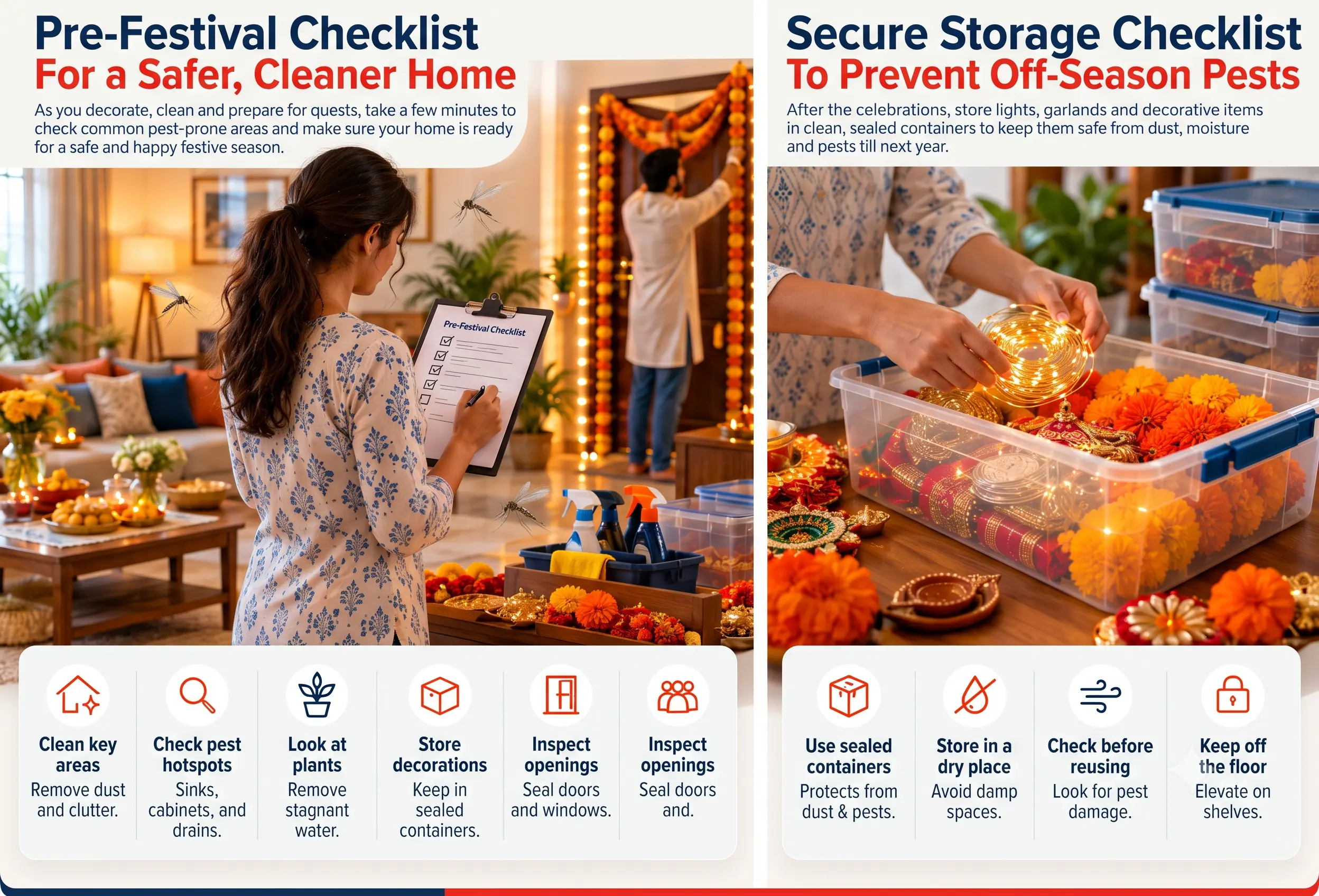
A useful inspection should focus on location, conditions and access, rather than simply looking for a visible pest.
| Step | Focus |
|---|---|
| Inspect | Check areas that are rarely moved, cleaned or opened |
| Check conditions | Look for food, moisture, clutter and other favourable conditions |
| Trace access | Examine gaps around doors, windows, pipes, drains and structural openings |
| Assess the scope | Determine whether the concern appears limited to one location or occurs across several areas |
This approach follows the broader principles of Integrated Pest Management, which emphasise monitoring and identifying pests, prevention and choosing appropriate control measures based on the situation. U.S. EPA's Integrated Pest Management principles provide further information.
Festive cleaning is an opportunity to look beyond the surfaces you normally clean and inspect the concealed areas of your apartment.
Behind appliances, inside cabinets, around plumbing, beneath furniture and within storage spaces can all provide useful clues about pest activity. Paying attention to these areas can help you identify potential problems before they become more difficult to manage.
A home may look clean on the surface while pest activity remains hidden elsewhere. A systematic inspection helps you understand what is happening in the places you cannot easily see.
Pay particular attention to kitchens, cabinets, areas under sinks, behind appliances, balconies, drains, storage spaces and around windows and doors.
Droppings, dead insects, egg cases, gnaw marks, damaged food packaging, ant trails, webs and unusual odours can all indicate pest activity.
Cleaning and decluttering can help make pest activity easier to identify. However, if you have an active infestation, it's useful to speak with a pest-control professional about the appropriate preparation and treatment.
It's a good idea to inspect hidden areas periodically, especially before major cleaning, festive seasons or when bringing stored items back into your living space.
Not necessarily. However, repeated sightings or additional signs such as droppings or egg cases can indicate a larger pest problem and should be investigated.
Discovering droppings, damaged packaging, insect activity or possible nesting areas may indicate a pest problem that needs further attention. Professional pest control can help identify the issue and determine suitable next steps.