18002122125 Call us toll free Contact us

Most Common Snakes Found In Winter

In India, winter is a season of Brumation - the reptilian equivalent of hibernation. Because snakes are ectothermic (cold-blooded), they cannot generate their own body heat and must seek out warm microclimates to survive the chill.

While overall snake sightings drop, certain species remain active or become more visible as they search for heat. Here are the most common snakes you might encounter during an Indian winter.

Russell’s Viper (Daboia russelii)

Unlike many other species, the Russell’s viper is actually quite active in winter.

  • The Reason: November to January is the breeding season for Russell's vipers in many parts of India.
  • Winter Behavior: While they are typically nocturnal, they often become diurnal (active during the day) in winter to bask in the afternoon sun.
  • Where to look: They are frequently found in woodpiles, scrap heaps, or near vehicle engines, as these spots retain heat.

Indian Rat Snake (Ptyas mucosa)

Commonly known as the Dhaman, this non-venomous giant is a frequent winter visitor.

  • The Search for Warmth: Because they are large, they lose body heat quickly. They often enter homes, godowns, or thatched roofs looking for insulation.
  • Appearance: They are often mistaken for cobras but lack a hood and have distinct black vertical lines on their "lips" (labial scales).

Common Krait (Bungarus caeruleus)

The Krait is a "low-temperature" specialist compared to the Cobra.
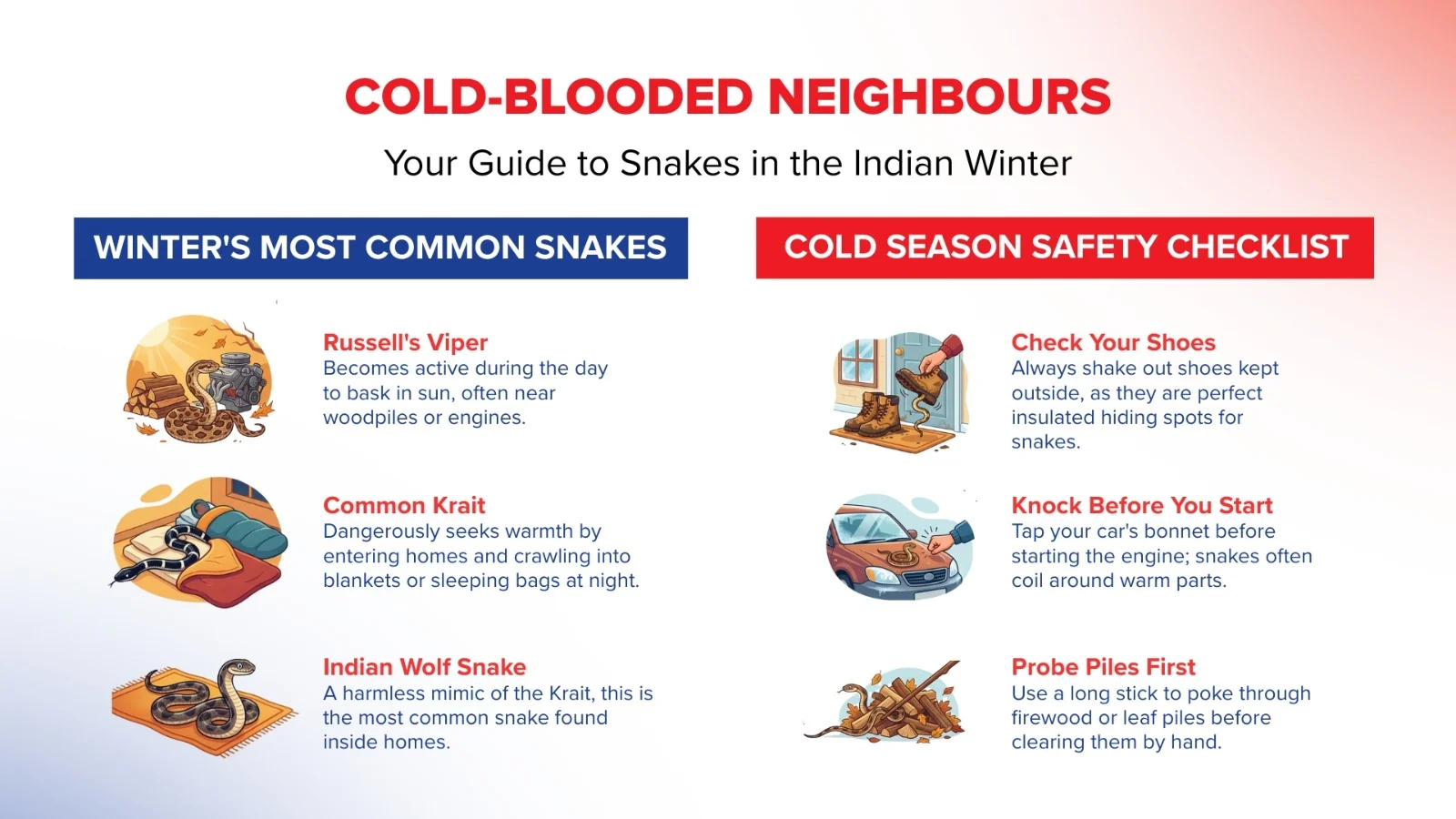
  • Winter Habit: Kraits are known to enter human dwellings specifically for warmth. They are famous (and dangerous) for crawling into blankets or sleeping bags with humans to share body heat.
  • Identification: Glossy black with thin white double bands. They are strictly nocturnal.
infographic for most common snakes in winter

Indian Rock Python (Python molurus)

The winter months (January–February) are the mating season for pythons.

  • Basking: You are most likely to see these massive snakes near water bodies or rocky outcrops during the day, where they "sunbathe" for hours to aid digestion and egg development.
  • Status: They are slow-moving in winter and generally non-aggressive unless provoked.

Indian Wolf Snake (Lycodon aulicus)

This is perhaps the most common snake found inside urban homes during winter.

  • Indoor Resident: They love the warmth of wall crevices, space behind cupboards, and air conditioning vents.
  • Harmless Mimic: They are non-venomous but often mistaken for the deadly common krait because of their white bands.

Learn About Top 10 Most Deadliest Snakes In India

Safety Tips for the Cold Season

  • Check Your Shoes: Always shake out boots or shoes kept outside; they are perfectly insulated "dens" for small snakes.

  • Engine Check: Before starting a car parked outside for a long time, give the hood a knock. Snakes often coil around warm engines.

  • Don't Move Piles Alone: If you are clearing a pile of dried leaves or firewood, use a stick first. These are the number one winter hiding spots for vipers.

Experience is everything

Don't just imagine your business with no pests...experience pest-free with Rentokil PCI.

Contact us today !