Registered Residential Customers
Manage Your Home Services
Mosquito-repellent plants are often promoted as a natural way to keep mosquitoes away from homes, balconies and gardens. Citronella, lemongrass, lavender, basil and marigold are among the plants commonly associated with mosquito control.
But there is an important distinction between a plant containing compounds that may repel mosquitoes and a living plant providing meaningful mosquito protection when placed around your home.
So, do mosquito-repellent plants really work? The answer is more nuanced than many gardening and pest-control claims suggest.
Some plants contain aromatic compounds or essential oils that have demonstrated mosquito-repellent activity in laboratory studies. However, this does not necessarily mean that simply growing the plant in a pot or garden will keep mosquitoes away.
For example, citronella grass is associated with citronella oil, which is used in mosquito-repellent products. However, Iowa State University Extension notes that plants such as citronella grass and scented geranium that are marketed as mosquito repellents are not effective simply when planted nearby. The repellent compounds are released much more readily when plant material is damaged or processed.
Research on plant-derived repellents also largely concerns extracts, essential oils or formulated products, rather than intact living plants.
A 2026 systematic review found promising repellent activity from several plant essential oils in controlled laboratory studies, while also noting that laboratory results may not translate directly to effectiveness in natural environments
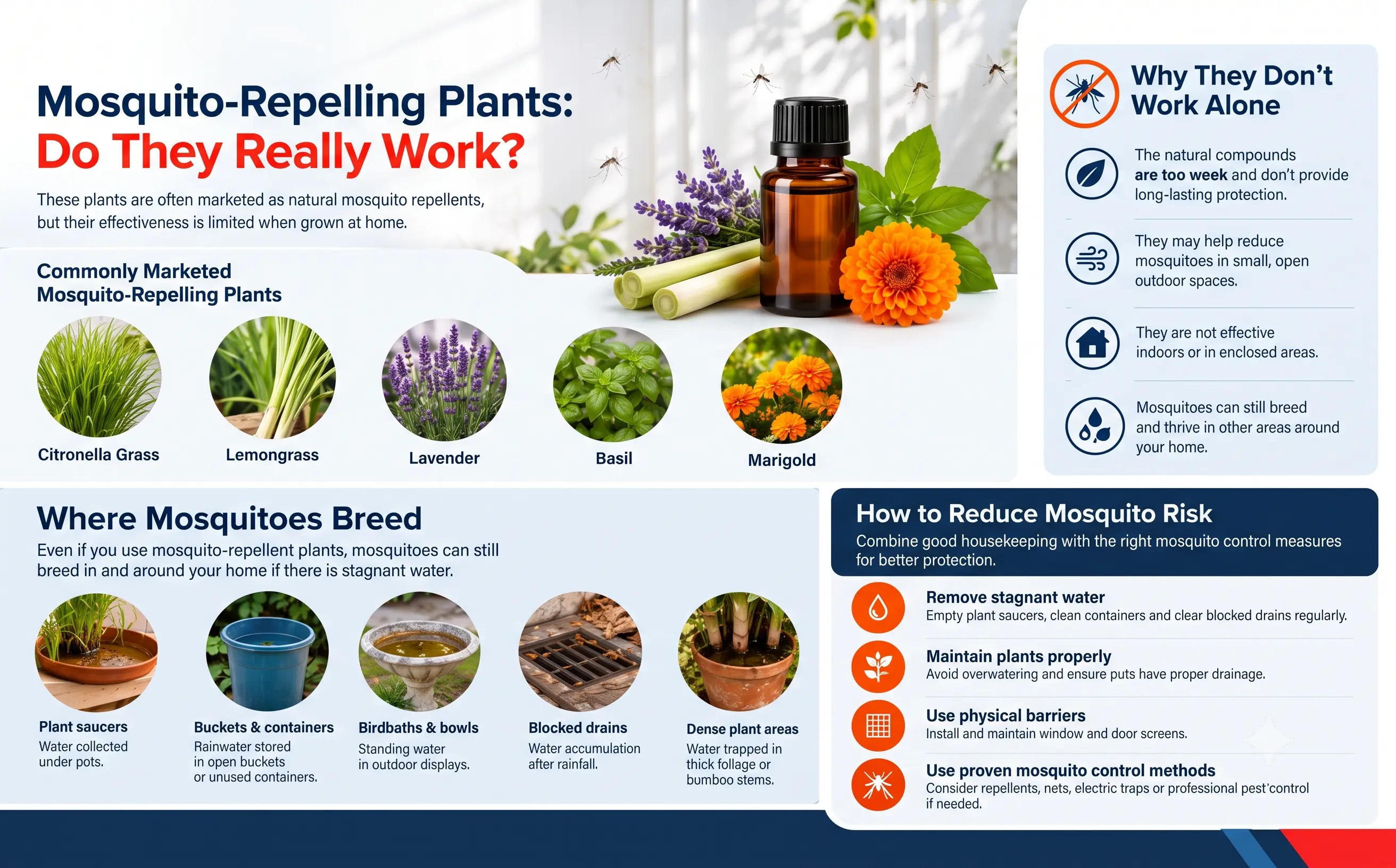
Several plants are frequently marketed as natural mosquito repellents. Their reputation generally comes from the compounds found in their oils or extracts rather than evidence that simply growing them around a home provides reliable protection
| Plant | Why it is associated with mosquito repellency | What to know |
|---|---|---|
| Citronella grass | Its oil contains compounds associated with mosquito repellency | Growing the plant alone does not provide the same effect as a formulated citronella-based repellent |
| Lemongrass | Contains aromatic compounds and is related to citronella-producing grasses | Evidence for repellency generally involves extracts or oils rather than an intact plant |
| Lavender | Its essential oil contains volatile compounds studied for insect-repellent activity | A potted lavender plant should not be treated as a reliable mosquito barrier |
| Basil | Basil oils contain compounds investigated for insect-repellent properties | Results from oils or extracts cannot automatically be applied to a living basil plant |
| Marigold | Commonly promoted as a natural insect-repelling plant | Claims about simply planting marigolds to control mosquitoes are not strongly supported |
A common assumption is that if a plant contains mosquito-repellent compounds, mosquitoes will detect those compounds from the plant and avoid the area.
In practice, several factors make this unreliable.
Essential oils and extracts concentrate volatile compounds from plant material. A living plant releases these compounds differently and often at much lower concentrations.
Repellency depends on the mosquito encountering a sufficient concentration of an active compound. Simply having a plant nearby does not guarantee that enough of its volatile compounds will reach mosquitoes.
Wind, air movement, temperature, humidity and the size of the area can all affect how long volatile compounds remain around a plant.
Research may test an essential oil, plant extract, isolated compound or formulated product. Those results cannot automatically be applied to a whole plant sitting on a balcony.
A review of plant-based mosquito repellents similarly notes that many studies use laboratory bioassays and that differences in testing methods make direct comparisons difficult.
Yes, potentially.
The plant itself is not necessarily the problem. Water that collects around it can be.
Plant saucers, trays and containers can retain water after watering or rainfall. If water remains undisturbed, they can become potential mosquito breeding sites.
This is particularly relevant for balconies, terraces and gardens where several potted plants are kept together.
The World Health Organization recommends eliminating standing water around homes, including water that collects in flowerpots and similar containers, as part of mosquito-breeding prevention.
For a more detailed inspection, see Rentokil PCI's 10-point checklist to prevent mosquito breeding. It covers plant trays along with other commonly overlooked sources of standing water.
Yes, if you like the plants.
Citronella grass, lemongrass, lavender, basil and other aromatic plants can be attractive additions to balconies, gardens and outdoor spaces. But they should be considered plants with potential insect-repellent properties, not a standalone mosquito-control method.
If your main goal is reducing mosquito activity, don't rely on plants alone.
A better approach is to combine:
The WHO recommends measures such as eliminating breeding sites, using screens and applying appropriate mosquito repellents as part of mosquito-bite prevention.
For a broader guide to household mosquito prevention and control, see how to get rid of mosquitoes at home
If mosquitoes are regularly present around your home, the priority should be to understand why they are there.
Start by checking for breeding sources such as:
Removing these sources addresses the mosquito population closer to its origin rather than simply trying to repel adult mosquitoes.
Where mosquito activity persists despite preventive measures, professional mosquito management can help identify breeding areas and determine appropriate control measures. Rentokil PCI provides professional mosquito control services for residential and commercial environments.
Living mosquito-repellent plants should not be considered a reliable standalone method of mosquito control.
Some plants contain compounds whose oils or extracts have demonstrated repellent properties, but that is different from simply placing the living plant around your home.
So, if you enjoy growing citronella, lemongrass, lavender or basil, there is no reason to stop. Just don't depend on them to create a mosquito-free zone.
The more effective approach is to eliminate breeding sites, reduce mosquito access and use appropriate protection or control measures when necessary.
Citronella grass is one of the most commonly associated with mosquito repellency, but simply growing the plant does not provide reliable protection from mosquito bites.
Lemongrass contains aromatic compounds associated with mosquito repellency, but a potted plant alone should not be relied upon for mosquito control.
No. Plants should not replace measures such as removing standing water, using appropriate repellents and preventing mosquito entry into the home.
Yes. Water collected in plant saucers and other containers can create breeding sites for mosquitoes.
A combination of eliminating standing water, preventing mosquito entry, using appropriate personal protection and addressing recurring mosquito activity is more effective than relying on plants alone.
Learn how professional mosquito control can help manage mosquito activity around your property and address potential breeding areas.
Book a Pest Inspection