Registered Residential Customers
Manage Your Home Services
The process by which ants develop from a tiny egg to a fully-formed bug is amazing, even though we typically only witness the adult ants marching in a line. Ants go through a full metamorphosis, a four-stage life cycle that is crucial to the colony's survival and operation, just like other insects. You can better appreciate the intricacy of these little animals if you comprehend this procedure.
When a queen ant deposits a little, oval-shaped egg, an ant's life begins. Usually white or translucent, these eggs are extremely little, frequently less than half a millimeter in size. During her lifetime, the queen may lay hundreds or even thousands of eggs, which are usually stored in a protected section of the nest.
A larva appears when the egg hatches. This larva is a legless, worm-like organism that is entirely reliant on the worker ants for care; it does not resemble an adult ant in appearance. Eating and growing are its main goals. The larvae are continuously fed by worker ants and undergo many skin sheds as they develop.
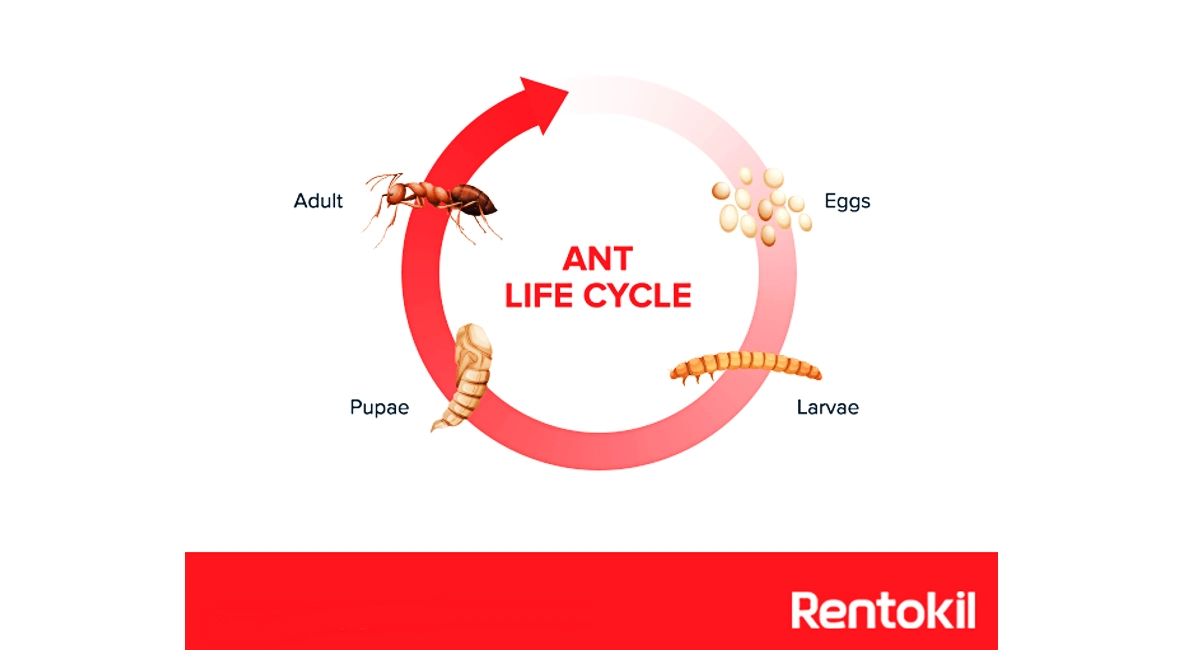
The larva moves into the pupal stage after reaching its maximum size. Pupae are stationary, non-feeding stages of development that resemble the chrysalis of a butterfly. In many species, the pupa is simply left uncovered, but in others, it is encased in a silk cocoon. The ant's body completely changes and reorganizes into the adult form during this stage.
At last, the pupa becomes an adult ant. When the ant's exoskeleton solidifies, its pale tint will get darker. The adult ant will perform a particular task within the colony based on its role:
The colony's egg-laying mechanism is called the Queen.
The only function of male ants is to mate with the queen.
The great majority of the colony are worker ants, who are in charge of gathering food, constructing the nest, and tending to the young.
The entire life cycle is a continuous process that enables a colony to grow and flourish, albeit its duration varies significantly depending on the species and environmental factors.
In addition to posing health problems, pests can cause property damage and damage to a company's reputation. Expert pest prevention techniques must be put into practice by taking precautions, but complete protection is possible when professional pest control services like Rentokil PCI are partnered with. Businesses can preserve a pest-free environment, safeguarding their operations and reputation, with our knowledge and customized solutions.