Registered Residential Customers
Manage Your Home Services
Most pest control findings in food safety audits stem from three areas: inadequate physical proofing, gaps in documentation and ineffective responses to pest activity. For food businesses in India, FSSAI inspections under Schedule 4 and BRCGS certification audits assess these areas through different regulatory and certification requirements.
BRCGS publishes non-conformance data that highlights recurring pest management weaknesses. FSSAI does not provide a comparable published ranking of pest control deficiencies. Accordingly, the FSSAI section below focuses on regulatory requirements and the evidence that food businesses should be prepared to demonstrate during inspections.
FSSAI's Schedule 4 specifies hygiene and sanitation requirements for food businesses, with Part I covering petty food businesses and Part II covering businesses applying for a licence. FSSAI's hygiene requirements provide further details on these provisions.
BRCGS Food Safety is a private, GFSI-recognised certification standard. Issue 9, published on 1 August 2022, includes pest management requirements under clause 4.14.
| Compliance Area | FSSAI (Schedule 4, Part II) | BRCGS Food Safety (Issue 9) |
|---|---|---|
| Nature | Statutory licensing requirement | Voluntary certification, often required by customers |
| Pest Control Requirements | Clause 9.2 and related clauses on building integrity, storage and waste | Clause 4.14, with related building-fabric, chemical and housekeeping requirements |
| Expert Assessment | No annual expert assessment specified under clause 9.2 | In-depth documented assessment by a pest management expert at least annually (4.14.10) |
| Trend Analysis | Not expressly specified under clause 9.2 | Required under clause 4.14.11 |
| Records | Pesticide and insecticide usage records, including dates and frequency; pest control records retained for the prescribed period | Site plans, monitoring records, treatments, corrective actions and trend analysis |
| Consequences of Failure | Improvement notices and possible suspension or cancellation of licence | Critical, major or minor non-conformances affecting certification |
Clause 9.2 of Schedule 4, Part II outlines pest control requirements. However, effective compliance also depends on related provisions covering building maintenance, drainage, storage, waste management and food safety documentation.
Inspectors may examine door seals, wall joints, drainage openings, damaged screens and unsealed service penetrations. Maintenance records should demonstrate that identified defects have been investigated and rectified.
Two additional sector-specific requirements are worth noting:
Failure to comply with an improvement notice within the specified period can result in suspension of the licence, with cancellation possible if deficiencies remain unresolved after re-inspection.
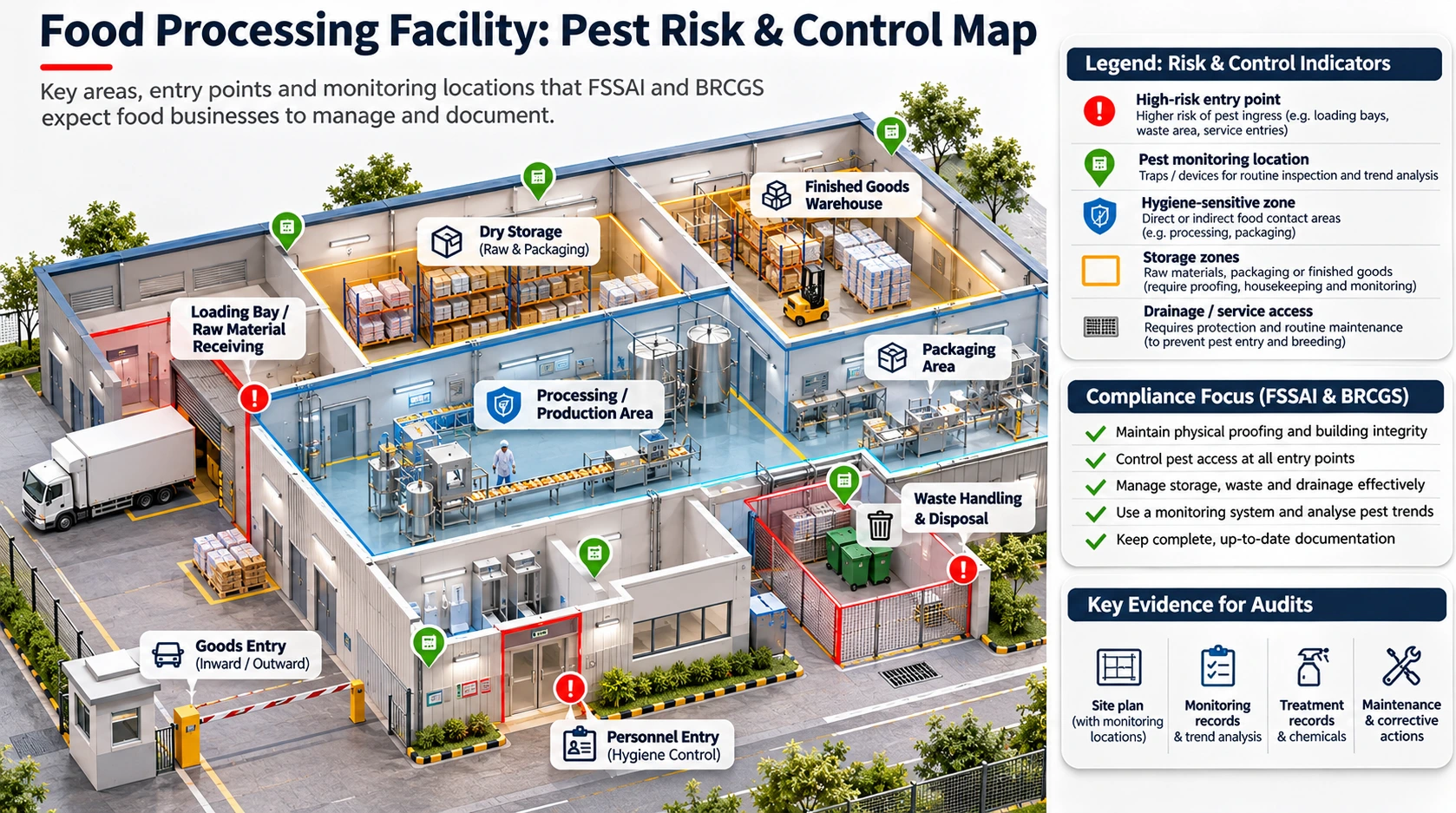
The following gaps combine published audit findings with FSSAI and BRCGS requirements. BRCGS interpretations from consultancy sources should be checked against the applicable licensed standard.
Damaged door seals, gaps beneath doors, unsealed cable entries and deteriorating wall joints can create entry routes for rodents and insects.
BRCGS expects effective pest exclusion through building maintenance, while FSSAI clause 2.5 addresses screens and self-closing doors.
What to check during an audit:
Preventive action: Implement scheduled proofing inspections, particularly around loading bays, receiving areas, drainage systems, and frequently accessed doors. Document identified defects, assign responsibilities, set closure dates, and verify post-repair.
BRCGS clause 4.14.10 requires an in-depth, documented assessment by a pest management expert at a risk-based frequency, at least annually.
The assessment should evaluate the effectiveness of the entire pest management programme, including monitoring coverage, infestation history, high-risk areas and the suitability of existing control measures.
It should also generate recommendations with clear responsibilities and timelines for implementation.
FSSAI clause 9.2 does not specify an annual expert assessment. Clause 8.1 instead requires periodic audits of the complete system against the SOP.
A routine contractor visit or general service report should not automatically be considered equivalent to the in-depth assessment required by BRCGS.
Monitoring reports that simply state whether pest activity was detected provide limited insight into the effectiveness of the programme.
BRCGS clause 4.14.11 requires trend analysis to identify recurring problem areas and improve pest management procedures.
Trend analysis should consider:
For example, recurring rodent activity around a loading bay may indicate an unresolved structural entry point or inadequate waste management. Similarly, repeated stored-product insect activity in a warehouse may require investigation of incoming raw materials, storage conditions and stock rotation.
Under FSSAI, businesses must also ensure that pesticide and insecticide usage records contain the required dates and frequency of application and are retained for the prescribed period.
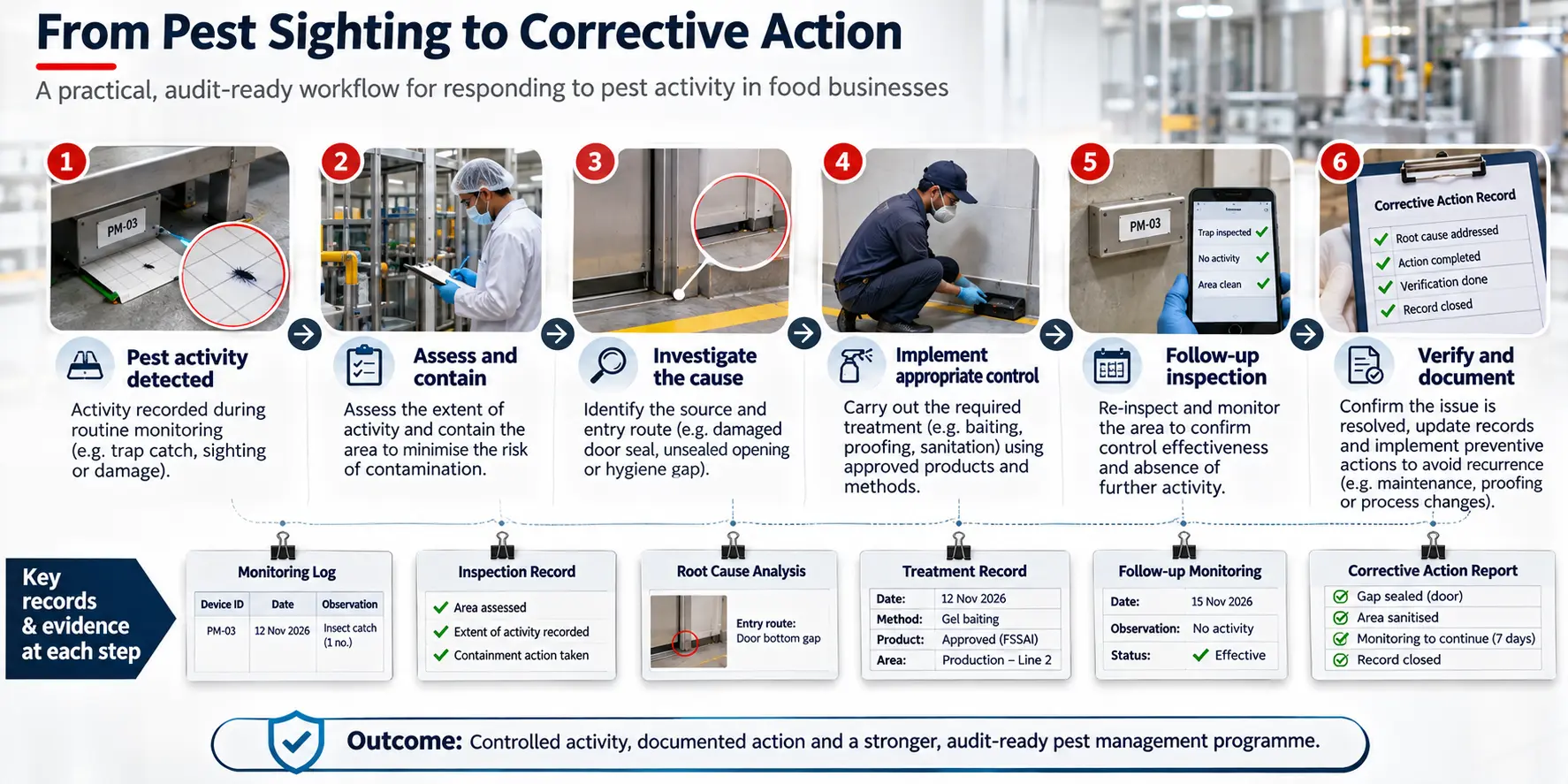
Treating an infestation without identifying why pest control failed can result in recurring activity.
An effective response should include:
For outsourced pest management programmes, the site and service provider should review the investigation and agree on corrective actions.
FSSAI clause 9.2.3 requires immediate action without compromising food safety. Documenting the investigation and subsequent actions provides evidence of an effective response.
Chemical storage and handling under BRCGS clause 4.9.1.1 is among the frequently reported non-conformance areas.
Common weaknesses include incorrectly labelled decanted chemicals, inconsistent application strengths and inadequate segregation of hazardous substances.
Pest control products should be included in the site's approved chemical register, with relevant safety data sheets and usage records maintained.
Key controls include:
Housekeeping is equally important. Poor sanitation, accumulated waste, standing water and inaccessible cleaning areas can create favourable conditions for pest activity.
BRCGS clause 4.14.12 expects staff to understand signs of pest activity, potential entry points, the influence of hygiene practices and the appropriate reporting procedures.
Food handlers and operational teams should be able to recognise:
Training records alone do not establish effective awareness. Staff should understand how to report sightings and ensure that identified issues are investigated and closed out.
Maintaining a centralised pest control file, whether digital or physical, helps food businesses demonstrate programme implementation and compliance.
The following documentation should be organised and regularly reviewed:
| Documentation category | Records to maintain |
|---|---|
| Programme establishment | Pest risk assessment, service scope, responsibilities and inspection frequency |
| Monitoring and implementation | Site plan showing device locations and identification codes, inspection reports and monitoring records |
| Treatment records | Products used, application dates, frequency and relevant treatment details |
| Programme performance | Trend analysis, infestation investigations and root cause analysis |
| Corrective actions | Corrective and preventive action records, assigned responsibilities and closure evidence |
| Competency | Contractor qualifications, relevant licences or approvals and staff training records |
| Chemical management | Chemical register and safety data sheets |
| Expert assessment | Annual in-depth assessment and recommendation closure records |
| Record retention | Pest control records retained for the applicable FSSAI period |
Records should be dated, traceable to specific locations or monitoring devices, reviewed by responsible personnel and supported by evidence of corrective action wherever necessary.
For example, a monitoring report identifying rodent activity at device R-014 should be traceable to its location on the site plan, the subsequent investigation, action taken and verification outcome.
The presence of a document alone does not establish that the pest management programme is operating effectively.
For businesses looking to strengthen documentation and monitoring, Rentokil PCI's pest control reporting services provide an overview of site risk assessments, service records, monitoring checklists, pest activity trends and field biologist reports.
Effective pest management in food manufacturing and processing facilities requires a preventive approach rather than dependence on reactive treatment.
Integrated Pest Management (IPM) combines risk assessment, environmental monitoring, structural proofing, sanitation and targeted treatment to manage pest activity while minimising risks to food products and processing environments.
An effective IPM programme should incorporate:
Rentokil PCI follows an Integrated Pest Management approach based on four principles: Exclusion, Restriction, Destruction and Monitoring (ERDM). This combines physical prevention, environmental management, targeted treatment and continuous monitoring.
Explore Rentokil PCI's Integrated Pest Management approach to understand how these principles are applied across commercial premises.
Preparing for an FSSAI inspection or BRCGS certification audit requires more than maintaining treatment schedules. Food businesses must demonstrate that pest risks are identified, preventive measures are implemented, monitoring results are evaluated and corrective actions are effectively closed.
A review of building proofing, pest monitoring records, chemical management practices and documentation can help identify gaps before an audit.
Yes. Clause 9.2.3 of Schedule 4, Part II requires records of pesticides and insecticides used, including dates and frequency. Clause 8.2 specifies retention of pest control records for one year or the shelf life of the product, whichever is longer.
Clause 9.2 does not specify an annual expert assessment. However, clause 8.1 requires periodic audits of the complete system against the SOP. BRCGS separately requires an in-depth annual assessment by a pest management expert under clause 4.14.10.
Relevant records include pest risk assessments, site plans, monitoring and inspection reports, treatment records, trend analysis, infestation investigations, corrective actions and annual expert assessments.
BRCGS does not prescribe one universal inspection frequency. The frequency should be established through the site's documented risk assessment and reviewed when significant changes or pest issues occur.
The authority may issue an improvement notice requiring corrective action within a specified period. Failure to comply can result in suspension or cancellation of the licence, subject to the applicable regulatory provisions.
Non-conformances are classified as critical, major or minor depending on the nature and severity of the failure. Campden BRI notes that evidence of a current or historical, poorly managed infestation is likely to be graded major because of its potential impact on food safety.
The investigation should identify the pest species, affected locations, potential entry routes, environmental conditions and operational factors contributing to the activity. Corrective treatment should be followed by verification and documented preventive action.
Part I of FSSAI Schedule 4 restricts spraying during business operations for petty food businesses. Part II requires treatment to be conducted without compromising food safety or product suitability. Treatment methods and timing should be selected in accordance with applicable requirements and product label directions.
Routine pest treatments alone may not be enough to demonstrate compliance. Review the key elements of your programme before your next food safety audit. Here's your audit readiness checklist: